


Being in the competitive digital era, where every click matters, User Experience(UX) has become one of the most powerful drivers of business growth.
A great user experience often goes above attractive visuals that creates a smooth, intuitive journey that matches user needs and also guides them towards meaningful actions.
So when a user uses a website or app that is effortless to navigate, loads quickly, and communicates clearly, users are more likely to engage, convert, and return.
At its core, UX design is all about being empathetic, understanding how users think, behave, and make decisions. While a well-structured user interface(UI) with clear calls-to-action, mobile responsiveness, and fast performance that helps to reduce friction and uncertainty.
It not just improves conversion rates but also builds customer trust as the users consider the brand as dependable and professional. Implementing important key UX principles such as clarity, usability, accessibility and speed optimization impacts how users interact with your digital platform.
When they experience a smooth flow whether signing up, purchasing, or browsing that they feel valued and understood.Ultimately great UX is not just a design choice rather it’s a business strategy.
It is only by prioritizing user needs and designing experiences which are simple, secure, and satisfying, that brands can increase customer conversions, develop loyalty, and develop lasting customer relationships which are based upon trust and credibility.
What does it mean to improve conversions through UX design?
Bloggyhands states that improving conversions through UX design involves strategically designing your website experience that guides users through your website and to increase the chances of them taking desired actions such as purchasing a product, filling out a form, or subscribing to a newsletter.
Conversion rate is the number of goal completions divided by total visitors, expressed as a percentage. Even if you make small UX improvements like easy navigation, clarifying CTAs, or improving page flow, it can increase the conversion rates.
Recent research shows that the average website conversion rate is between 2.5% to 3%. Doubling that rate does not just increase sign-ups but it can more than double revenue from existing traffic.
While User Experience(UX) focuses on the overall journey and emotional satisfaction, Conversion Rate Optimization(CRO) is the process of testing, analyzing, and improving specific actions.
Great UX and conversions are deeply connected which builds trust, removes obstacles, and helps users take action, converting good design into business results.
What Are the Core UX Principles That Drive Conversions?
Effective UX design converts user intent into action by removing obstacles and guiding attention. Below are six core principles that show how thoughtful design decisions directly improve conversions by focusing on clarity, trust, and usability.
1. Reduce Friction and Guide People:
Visitors should accomplish tasks effortlessly. If there is unclear navigation, excessive options, or hidden menus that cause confusion and drop-offs. It is only by simplifying navigation, using intuitive labels, and organizing clean layouts to help users stay focused and complete actions effortlessly that creates a smooth journey that naturally leads to higher conversions.
2. Interface Design and Visual Hierarchy:
A clear visual gains attention naturally. So it is essential to use contrast, spacing, and color to emphasize CTAs and essential information. Keep primary buttons visible and avoid clutter. Logical layouts make decision-making easier and reduce hesitation.
3. Simple Menus and Predictable Paths:
Consistency develops confidence as when users can easily navigate through what happens next where they feel in control then they are more likely to continue their journey without hesitation.
Consistent navigation and organized content help users know exactly where to go. Reduce distractions by removing redundant links. When users can predict interactions, they feel in control encouraging conversions.
4. Mobile Responsiveness and Fast Load Times:
Over 70% of visitors browse via mobile devices so it is essential to optimize images, reduce scripts, and make sure that the layouts adjust smoothly to screen size. While speed is not optional as each second of delay costs conversion and customer trust.
5. Clear Content and Trust Signals:
Bloggyhands states that you need to always make sure that your content should be simple, convincing, and human. So it is essential to add testimonials, security badges, and recognizable client logos to support credibility. With transparent and authentic messaging ensures users that your brand is dependable and secure.
What Real Methods Work to Improve Conversions Through UX Design?
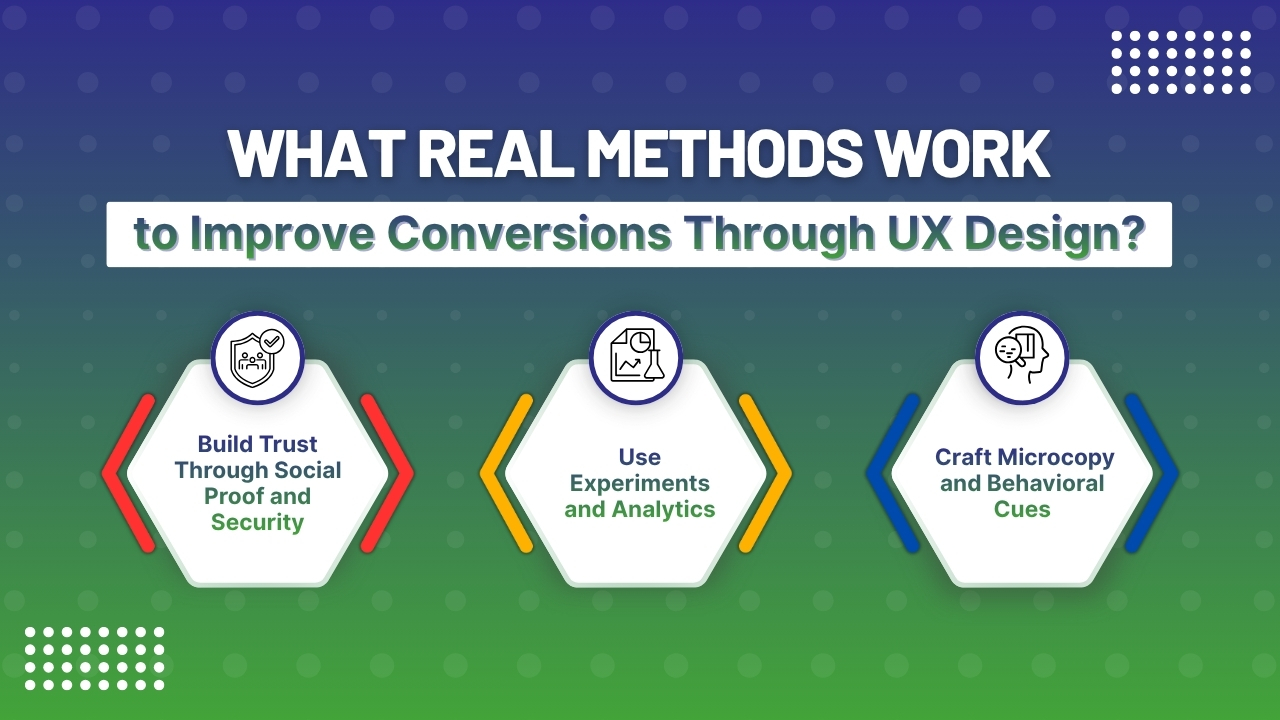
Transforming UX design principles into measurable results requires practical, data-driven methods. Below are some proven strategies to improve conversions by building trust, reducing friction, and aligning user behavior with business goals.
1. Build Trust Through Social Proof and Security:
As it is widely known, trust is the foundation of every conversion. Visitors hesitate when they are not sure about the credibility or security of a brand.
So ensure you include testimonials, ratings, customer logos, and third-party endorsements which reassures users that many others have had positive experiences.
Having features like SSL encryption, transparent privacy policies, and clear refund policies ensures visitors that their information is safe, lower issues and encourages users to move forward with confidence.
2. Use Experiments and Analytics:
Successful UX design requires testing and not assumptions. A/B testing allows us to compare variations of layouts, copy, or CTAs to find the factors that drive higher customer engagement. Many tools such as Google Analytics reveal user behavior patterns which show when users leave pages.
One experiment showed that simplifying an overly detailed pricing table improved sign-ups by 12%, highlighting how evidence-based UX adjustments can achieve stronger results than depending on instinct alone.
3. Craft Microcopy and Behavioral Cues:
Even short, carefully chosen words can influence user emotions and decisions, making microcopy a powerful tool for guiding behavior and increasing conversions.
Clear and concise microcopy helps users understand what to do next and builds confidence with simple lines like “Start free, no credit card required” lower perceived risk and encourage action.
The Psychology Behind User Trust
Trust is the invisible foundation of every successful digital experience. It’s not something users consciously seek, but rather something they feel while they interact with a website or product. Without trust, even the most visually attractive design fails to convert.
Trust enables brands to win loyalty, command premium pricing, and drive repeat engagement. In UX design, trust is not built overnight rather it’s earned through consistent, transparent, and emotional experiences.
1. Predictability and Consistency:
Users feel confident and relaxed when a website or app functions consistently and matches with customer’s expectations, creating a smooth and reliable experience.
By using consistent design elements such as buttons, fonts, colors, and layouts offers stability to users where they feel secure, knowing the interface will respond predictably throughout.
When a “Buy Now” button shifts position or changes color between pages, it can subconsciously indicate inconsistency, causing users to hesitate and lose confidence in the site’s reliability.
Offering predictable design reduces mental effort, allowing users to navigate effortlessly and trust each interaction. This sense of familiarity builds confidence, ultimately encouraging them to complete desired actions and convert.
2. Transparency and Control:
Transparency is the center of digital trust. By providing clear pricing, upfront policies, and visible security indicators like SSL badges or refund guarantees ensures integrity.
When users get control like the ability to review or modify their cart, adjust settings, or opt out of marketing creates a sense of empowerment. And it is only when users feel in control that they consider the brand as fair and trustworthy.
3. Emotional Resonance:
Trust is not only about features rather it’s a feeling. Small microcopy or friendly success animations add warmth to the experience. Displaying thoughtful messages during load times or form submissions reassure users that progress is happening.
Such small emotional touches make technology feel human and when users sense care and attentiveness then they associate the brand with reliability transforming simple interactions into lasting relationships which are built on trust.
How UX Directly Impacts Conversion Metrics
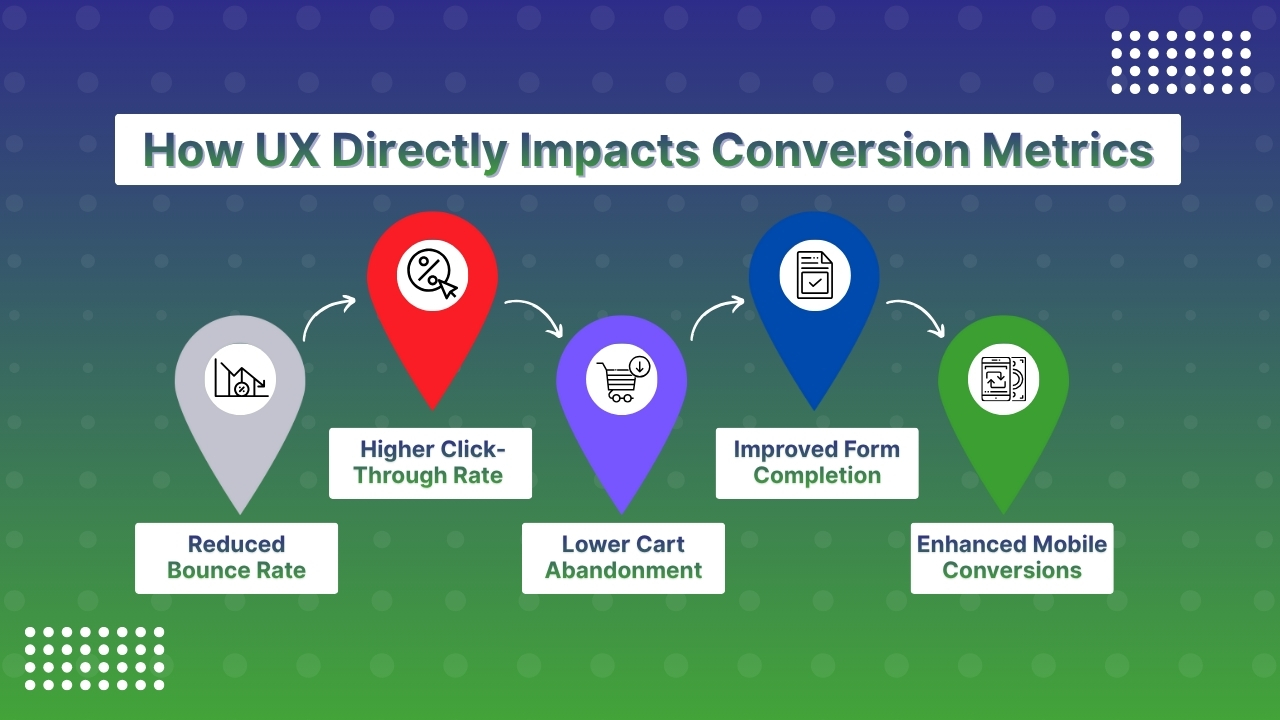
Let’s break down exactly how improving user experience can increase conversions and retention, increasing average order value and NPS, and reducing support costs.
1. Reduced Bounce Rate:
When users find what they need easily then they stay. With simple navigation, clear CTAs(Calls to Action), and valid visuals keep users engaged. And every second longer on your site increases the chance of conversion.
2. Higher Click-Through Rate (CTR):
A clear layout with bold headlines, high-contrast buttons, and logical flow draw attention to your CTAs. A recent research shows that strategically designed CTAs can improve conversions by up to 83%.
3. Lower Cart Abandonment:
One of the top reasons for abandoned carts is poor UX. When users get complex checkout flows, unexpected shipping costs, and compulsory sign-ups keep them frustrated.
Simplify the process, use auto-fill, showing progress bars, and reassuring users with visible trust badges can significantly reduce abandonment.
4. Improved Form Completion:
Long or unclear forms crush conversions as many users abandon carts halfway. Using inline validation, grouping related fields, and making nonessential questions optional can increase form completion rates by roughly 30–50%.
5. Enhanced Mobile Conversions:
With more than 70% of web traffic coming from mobile, it is essential to offer responsive and thumb-friendly design to users. When you provide Mobile-first UX with fast loading, large tap zones, and vertical layouts can double your conversions.
The UX Trust Cycle: From First Click to Repeat Purchase
A strong UX does not stop at the first conversion rather it nurtures loyalty and repeat engagement. The UX Trust Cycle turns first click into lasting relationships by guiding users through five reinforcing stages:
1. Attraction:
Clean design, quick load times, and a clear value proposition hook users at first glance. Clear headings and scannable copy make your offer instantly understandable and worth exploring.
2. Assurance:
Consistent branding, plain-language messaging, reviews, and visible security badges reassure users and reduce hesitation. Transparent pricing and policies indicate integrity, so users feel safe moving forward rather than second-guessing the next step.
3. Ease:
Intuitive navigation, accessible patterns, and friction-free flows reduce effort. Autofill, smart defaults, and clear progress indicators keep high momentum and avoid stalls that cause abandonment.
4. Satisfaction:
Thoughtful micro-interactions, helpful empty states, and timely confirmations make task completion feel satisfying. The support that’s quick and empathetic turns small interruptions into moments of care and not frustration.
5. Loyalty:
Personalized recommendations, saved preferences, and reliable performance bring people back. Over time, returning who trust your experience and are far more likely to convert again usually nearly 67% and to advocate for you.
When this cycle repeats, conversions become habitual. A returning customer who trusts your experience is up to 67% more likely to convert again than a first-time visitor.
Elements of a Conversion-Focused UX
To truly improve conversions and trust, every UX element must work like a step in a sales funnel.
1. Clarity of Purpose:
Only within five seconds, your visitors must understand the value of your brand. Use headlines that show benefits rather than features. For instance, “Book Your Dream Vacation Instantly” communicates outcome and speed more than the unclear, techie label “Advanced Travel Portal”.
2. Visual Hierarchy:
Guide the eye in a clear sequence with headline, benefits, and then a decisive Call to Action. Make sure you use contrast, color, and adequate whitespace to create visual hierarchy. Ensure that the primary options are obvious and consistent so that users never have to search or second-guess.
3. Navigation & Architecture:
Keep navigation short, logical, and consistent. Ensure a persistent “Home” anchor is always visible. Reduce steps and clicks, for every click increases friction, confusion, and loses users. Prioritize clear labels, keep menus shallow, and make navigation predictable across every page.
4. Mobile-First Design:
Design mobile-first for thumbs, focus on vertical scrolling, swift loading, generous tap targets. Reduce requests, compress images, defer scripts, and avoid pop-ups, hover-only menus, or elements that demand pinching or zooming.
5. Speed & Performance:
Every second counts while even a one-second delay can reduce conversions by 7 percent. Compress and lazy-load images, enable browser caching, reduce redirects and render-blocking scripts. Faster pages feel trustworthy, usable, and worth returning for customers.
Conclusion:
Great user experience turns curiosity into commitment. When pages load fast, navigation is obvious, and headlines display clear benefits, where visitors feel in control and build trust.
Predictable layouts, readable contrast, and accessible interactions reduce effort and allow people to focus on their goals instead of understanding your interface.
Microinteractions, confirmations, and helpful empty states offer constant reassurance as every tap gets a response, every action has a result. Mobile-first design and large tap targets avoid errors while transparent pricing, reviews, and security cues remove last-minute doubt.
Together such cues lower friction at every step, increasing click-throughs, form completion, and checkout success. Trust increases when you listen and improve.
Heatmaps and session replays increase friction; while surveys explain why it happens. Let the data guide you to reduce steps, tighten language, and put the most important actions.
Then validate changes with A/B tests and keep what works. Over time, a calm consistent UX becomes a brand promise that “we respect your time, protect your data, and make success simple”. It reduces support costs, return and churn. Such promise is what converts today’s visitor into tomorrow’s loyal customer.
John Doe
Digital Marketing Expert
Passionate about creating valuable content that helps businesses grow through digital marketing and innovative strategies.