



In today’s highly competitive digital market, having a well performing HVAC website design is crucial to gain attention of customers, and generate leads.
Homeowners and businesses who are searching for heating and cooling services expect fast, mobile-friendly, and professional searching for heating and cooling services expect fast, mobile-friendly, and professional websites which makes it easy to request service, schedule appointments, or get emergency support.
The best HVAC contractor websites are not just designed in modern templates but also should improve conversions, credibility, and increase local visibility on search engines.
A professionally well designed HVAC company website includes features which help to convert visitors into customers by using strong call-to-action buttons, easy online scheduling, customer testimonials, mobile-friendly layouts, and fast loading pages that improves the overall user experience.
In 2026, users also expect to smoothly navigate through websites, local SEO optimization, and trust-building elements that makes selecting an HVAC provider easier.
Without having these critical features, businesses risk losing potential leads to competitors with stronger online experiences. Modern HVAC web design services focus on user experience, generating leads, and search engine performance to help companies to grow in competitive local markets.
Whether you are running a residential HVAC business or a commercial heating and cooling company, investing in the accurate website design features can highly increase website traffic, customer inquiries, and ensure long-term business growth.
Also Read: Design That Converts Why UX is the New Sales Funnel
What Makes an HVAC Website Great?
A high performing HVAC website should quickly convey their services, build trust from potential customers, and offer a fast, simple way for homeowners to contact your business when they require help the most.
The strongest HVAC websites usually include:
-
A clear headline that explains the service and location
-
A sticky phone number or “Schedule Service” button
-
Dedicated pages for AC repair, furnace repair, heat pump service, maintenance, installation, indoor air quality, and emergency service
-
Real team, truck, project, and customer photos
-
Review badges, certifications, warranty information, and financing options
-
Fast mobile loading and simple navigation
-
Local city pages or service-area content
-
Helpful guides that answer common HVAC questions
-
LocalBusiness schema, service schema, FAQ schema, and clean technical SEO
Google indicates local rankings are mainly based on relevance, distance, and prominence. For HVAC companies, it means your website and Google Business Profile need complete service information, accurate location details, reviews, and strong local signals.
Local Business structured data can also help Google to understand important business details like hours, departments, and service information.
Also Read: How Holy Spring Needs Professional WebDesign
Top HVAC Website Design Features That Drive More Leads in 2026
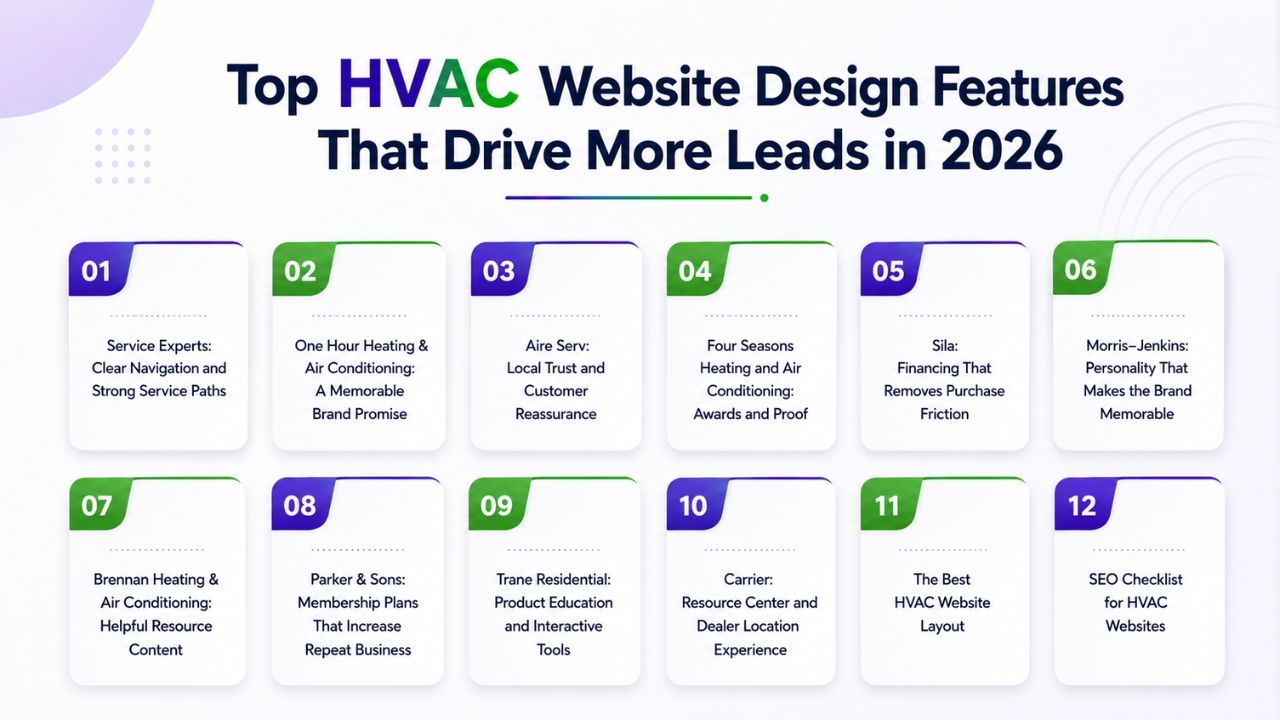
1. Service Experts: Clear Navigation and Strong Service Paths
Service Experts is a strong example as the website makes the customer journey simple. The layout focuses on clear service categories, residential and commercial options, emergency service access, and location-specific content.
This matters because HVAC customers usually arrive with a specific problem. While they do not just search for “HVAC”. They search for “AC repair near me,” “furnace not heating”,”heat pump installation,” or “emergency HVAC service.”
The key is to design your website navigation based on customer search by developing clear sections for HVAC repair, installation, maintenance plans, emergency services, and financing options, and also place strong call-to-action buttons throughout the website to encourage conversions.
Also Read: What are Five Marketing Strategies that Retailers Spend Half of their Annual Budget
2. One Hour Heating & Air Conditioning: A Memorable Brand Promise
One hour Heating & Air Conditioning captures attention by emphasizing its commitment to on-time HVAC service directly on the homepage. The site uses many conversion tools like live chat, online scheduling, and technician tracking.
Such an approach works well because many HVAC customers get frustrated with delayed service appointments, unclear arrival times, and poor communication from contractors.
A strong guarantee sets a business apart by reassuring customers and making it easier for customers to choose one HVAC provider over another.
The key takeaway is to establish a clear and specific service promise that sets your HVAC business apart such as providing same-day AC repair, transparent upfront pricing, fully certified and background checked technicians, or a guarantee your team leaves every home clean after service.
Ensure this promise is immediately visible in the crucial section of your website so visitors can see it first.
Restate this promise again near your booking or contract forms to reduce customer hesitation while deciding. Support the message with customer reviews and testimonials that validate your claims and build trust.
3. Aire Serv: Local Trust and Customer Reassurance
Aire Serv uses local franchise information, pricing promises, technical trust signals, and community-focused content. It works because HVAC is a local trust business. Homeowners are inviting your technicians into their homes, so the website must reduce uncertainty.
The key takeaway is to make your HVAC business to seem more personal and trustworthy by showing the real people behind your services. Include technician profiles, images of the local owner, and genuine customer reviews to gain trust and strengthen the connection with potential customers.
Improve the credibility of your HVAC business further with trust badges, certifications, and a clear “why homeowners choose us” section that shows the value of your services.
If your business operates in multiple cities, create dedicated service-area pages customized to each location instead of using a single generic page so customers can easily view your businesses that you truly serve their community.
Also Read: What is Geo Advertising and Marketing
4. Four Seasons Heating and Air Conditioning: Awards and Proof
Four Seasons uses awards, certifications, and customer satisfaction signals to strengthen credibility. This is crucial because many HVAC companies promise similar facilities like fast service, expert technicians, fair pricing. While providing the proof makes the claim stronger.
The key takeaway is to ensure your HVAC website immediately conveys trust by placing important credentials where visitors can see them right away. Display certifications, licensing, and insurance information, manufacturer partnerships, year of experience, customer review counts, awards, and financing options prominently near the top of your homepage.
These crucial trust indicators should be placed prominently on high-visibility areas of your website instead of being placed away in footers or less-visited secondary pages.
Rather they should appear before a visitor reaches the booking decision that helps to reduce any form of hesitation and build confidence from the very first interaction.
5. Sila: Financing That Removes Purchase Friction
Sila’s website is useful because it addresses one of the biggest HVAC buying objections which is cost. Sila emphasizes financing options, flexible payment solutions, special offers, and clear pricing information to make HVAC services more accessible and transparent for customers.
HVAC replacements can be expensive, and many customers delay action because they are worried about the price. Financing pages, payment options, specials, and estimate tools reduce customer hesitation by making HVAC services feel more affordable and easier to commit to.
The key takeaway is to make financing options highly visible throughout. Add a prominent “Financing Available” button in the site header so users can quickly access payment options.
Clearly explain monthly installment plans in simple terms and highlight any current rebates or promotional offers. Create a dedicated, easy-to-understand page that breaks down installation costs transparently.
For campaigns focused on replacements, use clear calls to action like “Explore Financing” and “Request a Free Installation Estimate” to encourage engagement.
6. Morris-Jenkins: Personality That Makes the Brand Memorable
Morris-Jenkins proves that HVAC websites do not have to feel cold or generic. The brand differentiates itself by adopting a warm, approachable voice, showcasing its team, and emphasizing local identity. This helps to build trust and stand out in competitive markets where many contractors offer comparable services.
The key takeaway is to develop a clear and consistent brand voice throughout. Use authentic images, conversational writing, and short-form videos to create a more warm connection.
Incorporate local expressions and references that feel familiar and genuine. Even with a well designed, professional website, the experience should remain personal and approachable. The goal is for homeowners to feel like they are reaching out to a trusted local team instead of an impersonal corporation.
7. Brennan Heating & Air Conditioning: Helpful Resource Content
Brennan shows the value of educational content which includes seasonal guides, troubleshooting tips, energy-saving information, and indoor air quality resources. This type of content supports SEO and helps customers before they are ready to book.
The key takeaway is to create content that directly shows the real questions homeowners are asking. Focus on practical, high-intent topics such as why an AC might be blowing warm air, how frequently furnace fillers should be replaced, and comparisons such as heat pump versus central air.
Ensure you include guidance on identifying when an AC needs repair and how to determine the right HVAC system size. Each piece of content should naturally connect to valid service pages.
Be sure to include clear calls to action that guide readers toward booking a service or requesting an estimate.
8. Parker & Sons: Membership Plans That Increase Repeat Business
Parker & Sons uses membership value, benefit comparisons, customer testimonials, and simple enrollments. This is smart because HVAC growth does not only come from emergency calls. Maintenance plans create recurring revenue and keep customers connected to your brand.
The key takeaway is to create a dedicated page for maintenance plans which clearly explains their value. Break down what each plan includes and compare different tiers side by side so customers can easily understand their options.
Highlight the benefits by showing how routine maintenance can help to avoid expensive breakdowns and extend the life of the system. Emphasize how regular tune-ups keep systems running efficiently for longer, while encouraging immediate action through clear CTAs such as “Join the Maintenance Plan” and “Schedule Your Seasonal Tune-Up”.
9. Trane Residential: Product Education and Interactive Tools
Trane’s website focuses on product details, energy savings tools, and customer testimonials. While Trane is a manufacturer, local HVAC companies can learn from this approach.
Many homeowners are unfamiliar with technical terms such as SEER ratings, heat pumps, ductless mini-split systems, smart thermostats, and indoor air quality add-ons.
The takeaway is to convert product confusion into lead generation. Add buying guides, comparison tables, calculators, and “which system is right for me?” sections. When customers feel informed then they are more likely to request an estimate.
10. Carrier: Resource Center and Dealer Location Experience
Carrier combines clean visuals, educational resources, FAQs, maintenance tips, and dealer-location functionality. For contractors, the lesson is not to copy a manufacturer site, but to create a resource center that supports both SEO and trust.
The key takeaway is to develop a centralized learning hub that organizes information into clear categories like cooling, heating, indoor air quality, maintenance, rebates, and troubleshooting.
Organize the content in a way that allows users to quickly locate solutions to their specific HVAC questions. Use clear navigation and topic based grouping to improve accessibility and understanding.
Include relevant internal links within articles that direct users to related service pages. This creates a seamless path that moves visitors from learning and exploration toward scheduling a service appointment.
Also Read: How to Get Your Business On Google
11. The Best HVAC Website Layout
A strong HVAC homepage should follow a conversion-focused flow:
-
Hero section with service, location, CTA, phone number, and trust badge
-
Emergency or same-day service strip
-
Main service cards for repair, installation, maintenance, and indoor air quality
-
Review and rating section
-
Why choose us section with guarantees, licensed technicians, and upfront pricing
-
Financing and specials section
-
Service-area section with city links
-
Maintenance plan promotion
-
Helpful FAQs
For service pages, use a slightly different structure. Start with the problem, explain symptoms, show how your team fixes it, list benefits, add pricing or financing details, include FAQs, and end with a strong booking CTA.
Also Read: Is Adding too Many Keywords Bad for Google Ads
12. SEO Checklist for HVAC Websites
To make your HVAC website easier to rank and easier to convert, focus on these essentials:
-
Create one page per core service
-
Add city-specific pages only when each page has unique, useful content
-
Keep your phone number, address, hours, and service areas consistent
-
Add LocalBusiness schema and FAQ schema
-
Compress images and improve Core Web Vitals
-
Make CTAs visible on mobile
-
Add internal links from blogs to service pages
-
Use real project photos instead of generic stock images
-
Collect and display fresh reviews
-
Track calls, form fills, quote requests, and booked appointments in analytics
Do not build an HVAC website only for search engines. Build it for the homeowner who needs help now. The better your site answers their problem, proves your credibility, and makes booking easy, the better it will perform.
Conclusion
The best HVAC websites are not always the flashiest. They are the clearest, fastest, most trustworthy, and easiest to use. A site with real local photos, strong service pages, reviews, financing, emergency CTAs, helpful resources, and smooth mobile performance will usually outperform a beautiful site that does not convert.
If you are redesigning an HVAC website in 2026, start with customer intent. What does someone need when their AC stops working, their furnace fails, or their utility bill keeps rising? Then build every section around that need. Make the next step obvious. Show proof early. Keep the content local. Make mobile speed a priority. Add tools, guides, and trust signals that help customers feel confident.
A great HVAC website should not just look professional. It should generate calls, booked appointments, maintenance plan signups, replacement estimates, and long-term customer relationships. That is the difference between a website that exists and a website that drives real HVAC business growth.
If you still have a query about best HVAC website design features that generate more leads then you may book a free demo at bloggyhands and we are more than happy to assist you.
John Doe
Digital Marketing Expert
Passionate about creating valuable content that helps businesses grow through digital marketing and innovative strategies.