

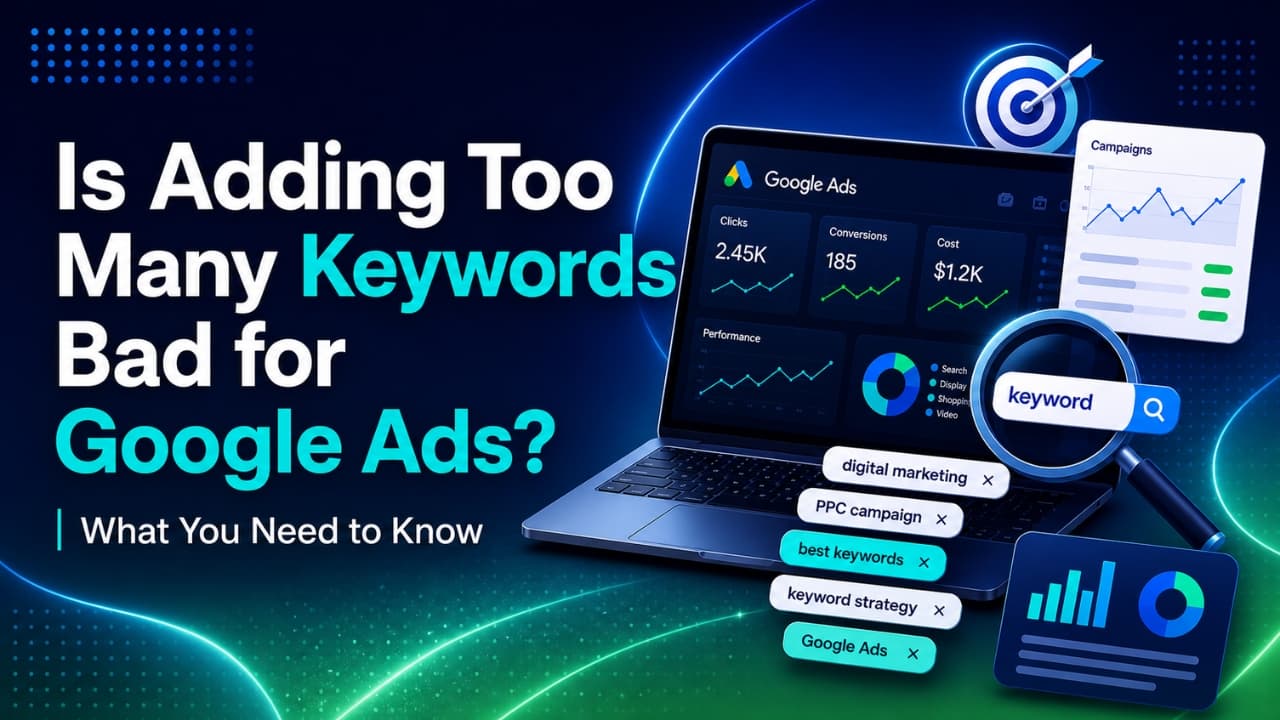
Adding too many keywords in Google Ads may seem to be a smart way to reach more people but if those keywords are not carefully managed then it can actually affect your performance of campaigns.
Google Ads works best when your keyword strategy is focused, relevant, and matches with real search intent. When advertisers overload their campaigns with broad, unrelated, or low quality keywords then it can lead to poor ad relevance, lower Quality Score, wasted budget, and fewer conversions.
A strong Google Ads campaign is not all about targeting every possible search term. Rather it is about choosing the Google Ads keywords which match with what your ideal customers are actively searching for.
By adding too many keywords can make your ad groups message, make your message weak, and make it harder to write ads that connect with each search query. As a result, your cost-per click conversion rate, and overall return on ad costs may suffer.
Through this blog, we will walk you through why adding too many keywords can be inappropriate for Google Ads, how it affects campaign performance, and how to build a cleaner, more profitable keyword targeting strategy using focused ad groups, match types, and negative keywords.
Also Read: Digital Marketing Strategy for Local Businesses
The Truth: More Keywords ≠ Better Results
More keywords do not always mean better Google Ads results. But adding keywords blindly can make your campaign harder for you to manage, less relevant, and less profitable. Google Ads performs well when your keywords are organized, focused, and connected to clear search intent.
A successful campaign relies on the quality of the keyword and not just on the quantity of keywords. Every keyword should support a clear purpose and align your ad copy, landing page, and customer journey.
When keywords are too broad or not properly grouped, then your ads may appear for searches that do not align your actual products, services, or ideal customers.
If your keywords are:
-
Too broad and attract users who are not ready to buy
-
Poorly grouped across unrelated ad groups
-
Weakly matched to your ads and landing pages
-
Not supported by negative keywords to block irrelevant searches
Then your campaign can:
-
Show ads for unrelated searches
-
Bring in low-quality clicks
-
Increase wasted ad spend
-
Lower conversion rates
-
Make optimization harder over time
Why Too Many Keywords Hurts Your Campaign
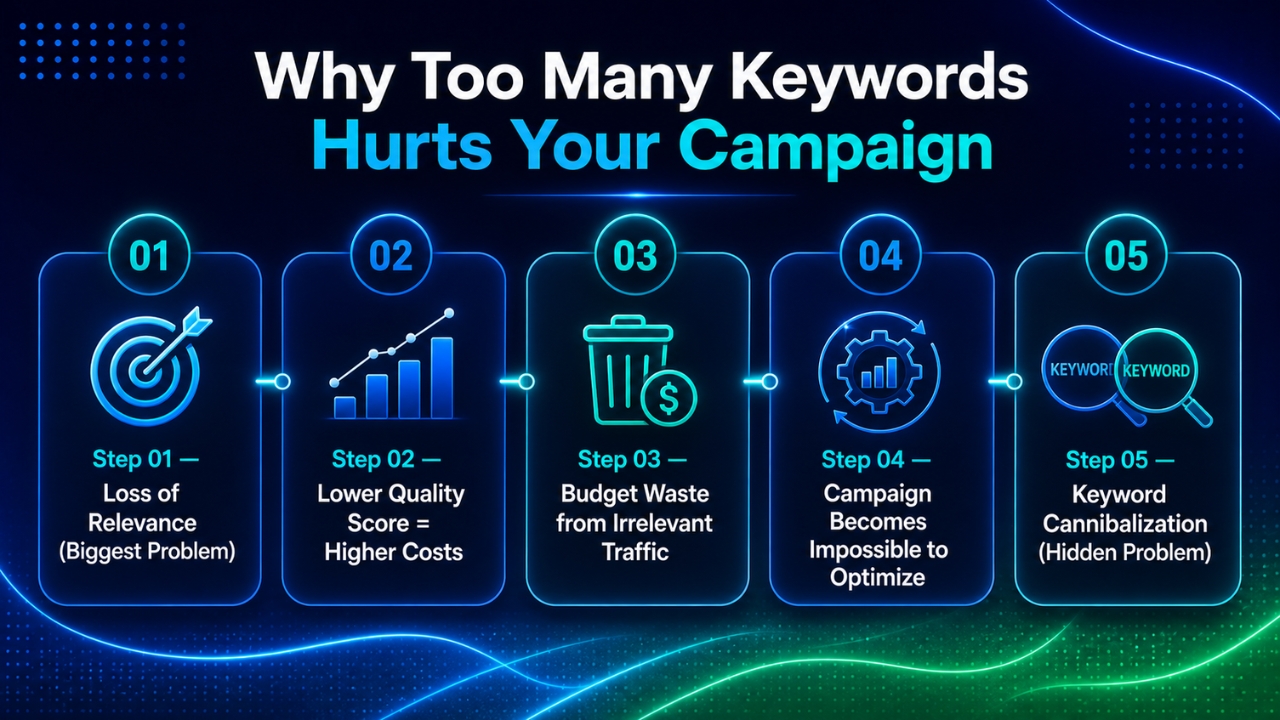
1. Loss of Relevance (Biggest Problem)
One of the biggest problems with adding too many keywords in Google Ads is loss of relevance. These ads perform best when the keyword, search query, ad copy, and landing page are closely connected. When the connection is strong, users are more likely to click your ad and take action.
When you add too many keywords in one ad group, then your campaign becomes less focused. Different searches may have different intent, but they may still trigger the same generic ad. This makes your message weaker and less useful to the user.
Too many keywords can cause:
-
Generic ad messaging
-
Unclear search intent
-
Poor keyword-to-ad matching
-
Less relevant landing pages
As a result, your campaign may see:
-
Lower CTR
-
Lower engagement
-
Reduced conversions
-
More wasted ad spend
2. Lower Quality Score = Higher Costs
When you add too many keywords can lower your Quality Score, which will directly affect how much you pay for clicks.Quality Score depends on ad relevance, expected CTR, and landing page experience. When your keyword list is messy, Google may see your ads as less useful to searchers.
If one ad group has too many different keywords, your ad copy may not match each search properly. This can reduce clicks, lower CTR. and make your campaign more expensive over time.
A messy keyword list can cause:
-
Poor keyword-to-ad matching
-
Lower expected CTR
-
Weak ad relevance
-
Less focused landing page experience
As a result, you may face:
-
Higher CPC
-
Lower ad rank
-
More wasted spend
-
Worse results from the same budget
3. Budget Waste from Irrelevant Traffic
Too many keywords can quickly cause budget waste from irrelevant traffic. When advertisers add a large number of keywords, it often includes broad, loosely related, or low-intent search terms. Though these keywords may generate clicks, they may not bring the right customers.
For instance, if you sell premium leather wallets, then your ideal should target people that are searching for quality wallets, or leather accessories. But if you add terms such as “cheap wallets”, “wallet repair”, your ads may appear for users who are not ready to buy your product.
This creates problems such as:
-
More clicks from the wrong audience
-
Higher spending on low-intent searches
-
Poor conversion rates
-
Less budget available for profitable keywords
As a result, you may start paying for traffic that will never convert. It is one of the most expensive Google Ads mistakes because it drains your budget without generating real business results.
Also Read: What are the Five Marketing Strategies that Retailers Spend Half of Their Annual Budget On
4. Campaign Becomes Impossible to Optimize
When you add too many keywords to a Google Ads campaign, then optimizing campaigns becomes more difficult. A successful campaign requires clear data because it helps you to understand that keywords are driving clicks, leads, sales, and wasted expenses. But when your keyword list is overloaded, performance data gets spread across too many terms.
Rather than seeing clear winners and losers, you may end up with scattered results. Some keywords may get few clicks, while keywords may have high expenses without enough conversions. It makes it difficult to make smart decisions regarding bids, budgets, match types, and negative keywords.
Too many keywords can create problems like:
-
Scattered performance data
-
Difficulty identifying profitable keywords
-
Harder bid adjustments
-
Confusing ad group structure
-
Slower campaign improvements
As a result, you are no longer actually optimizing your campaign. You end up chasing confusing data, fixing constant issues, and spending more time fixing problems than improving results.
5. Keyword Cannibalization (Hidden Problem)
Keyword cannibalization in Google Ads occurs when several keywords in your account compete for the same or very similar search query. It often occurs when advertisers add too many keyword variations without a clear structure.
For instance, keywords such as “buy shoes online”, “online shoes purchase” may all target the same type of user. Rather than giving Google a clean signal about which keyword should best, you create overlap inside your campaign.
This can cause issues such as:
-
Multiple keywords triggering the same search
-
Confusing performance data
-
Unclear winning keywords
-
Harder bid management
-
Less accurate optimization decisions
When Google rotates between similar keywords, your data becomes harder to read. One keyword may get clicks one day, while another keyword gets similar traffic later.
As a result, you may not know which keyword is truly driving results. This causes inefficient spend, weak performance indications, and slower campaign improvement.
Also Read: Explain How Social Media Has Impacted Marketing for Small Businesses
What Google Actually Wants
Google Ads rewards campaigns that use relevant, well-organized keywords that align with clear user intent and are helpful to users. While the goal is to display the right ad to the right person at the right time.
For better performance, focus on these three things:
1. Intent Matching
Your keyword should align exactly with the intent behind the user’s search. Because searching for “buy running shoes online” has a different intent than someone searching for “better running shoe brands.” When your keywords match clear intent, then your ads attract more qualified clicks.
2. Ad Relevance
Your ad copy should closely align with the product and service that the user searched for. Because when people see your ad, they should feel that it is exactly the ad or services which they were looking for. Having a strong keyword relevance helps businesses to improve CTR, engagement, and conversion rates.
Also Read: Geo Advertising Vs Traditional Marketing
3. Clean Structure
It is essential to create small, focused ad groups as it usually performs better than large, messy ads. Because a clean structure helps to group similar keywords together, write specific ads, improve Quality Score, and control your expenses more effectively.
Ideal Keyword Strategy (Modern Approach
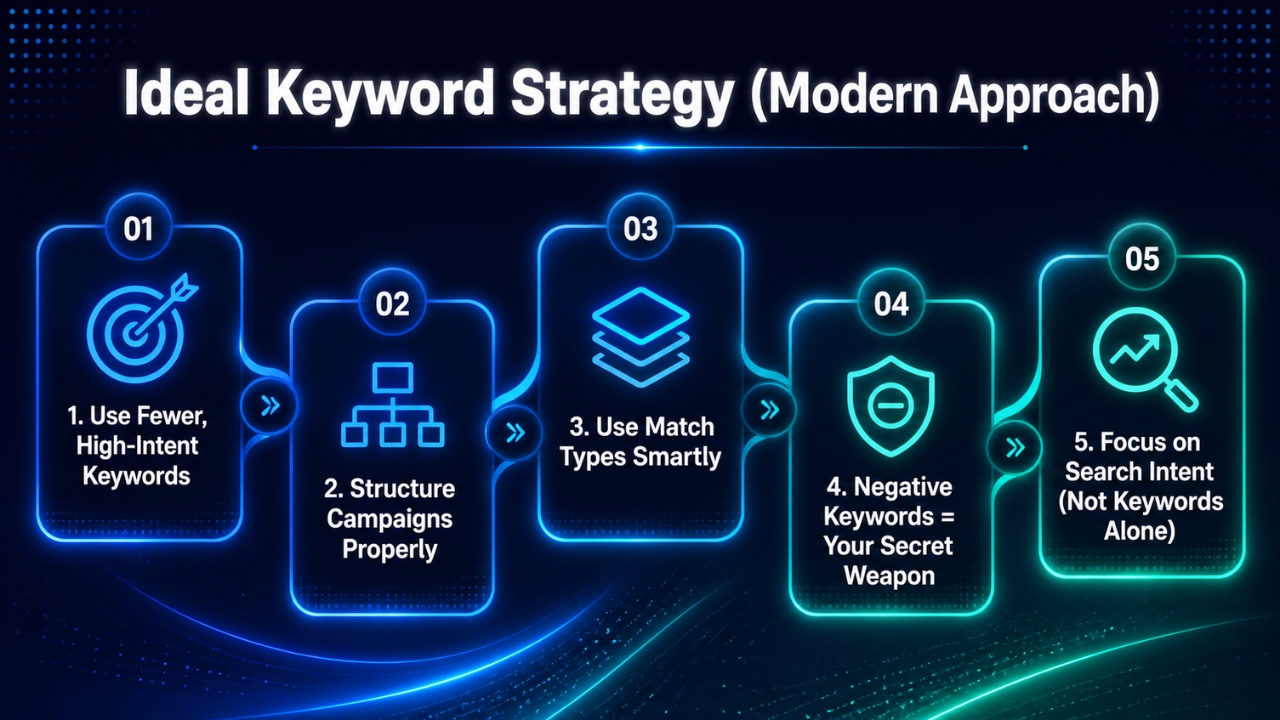
1. Use Fewer, High-Intent Keywords
A smarter Google Ads strategy is to use few, more focused keywords instead of adding hundreds of keywords. High-intent keywords are more impactful because it shows that the user is very close to taking action such as buying, booking.
For instance, instead of using 100 unrelated keywords, ensure you create each ad group around 10-20 strongly related keywords with the same search intent.
Example Ad Group: Men’s Leather Wallets
-
buy leather wallet men
-
premium leather wallet
-
genuine leather wallet men
-
leather wallet online
This works better because:
-
All keywords share the same intent
-
Ad copy can be more specific
-
Landing pages can match the search
-
CTR and conversions can improve
-
Budget is spent on more qualified traffic
Focused keywords help to create cleaner campaigns and stronger results.
Also Read: How to Get Your Business On Google
2. Structure Campaigns Properly
Having a proper Google Ads campaign structure helps to keep your keywords, ads, and landing pages organized. Instead of placing every keyword into one large ad group, divide your campaign on the basis of user intent, product type, service category, or theme.
A good structure looks like this:
-
Campaign
-
Ad groups based on intent or theme
-
Closely related keywords inside each ad group
-
Specific ads written for that keyword group
-
Relevant landing pages matched to the search
A bad structure looks like this:
-
One ad group with more than 100 keywords
-
Mixed search intent
-
Generic ad copy
-
Poor keyword control
-
Confusing performance data
When your campaign has proper structure, it becomes easier to improve ad relevance, manage bids, track performance, and reduce any unwanted expenses. Having a clean structure helps Google to understand your campaign better which can support stronger results with time.
3. Use Match Types Smartly
Using the right keyword match types is essential for controlling when your ads appear in Google Ads. Every match type has a different level of reach and control, so you should select keyword matches based on campaign goals, budget, and search intent.
-
Exact Match
Exact match must be used for high-intent keywords. Such keyword match gives the most control and usually brings users who are quite close to conversions. This causes better-quality traffic and a higher conversion rate.
-
Phrase Match
Phrase match offers a balance between reach and control. It helps your ads appear for searches that include your keyword meaning while still avoiding many unrelated searches.
-
Broad Match
Broad matches help to reach more people but it should be used carefully. Such matches can be used only when you have smart bidding, strong conversion tracking, and a strong negative keyword list to block irrelevant traffic and reduce wasted ad expenses.
4. Negative Keywords = Your Secret Weapon
Negative keywords are one of the most powerful ways to improve the performance of Google Ads. Instead of always adding more keywords, you should remove searches which bring the wrong audiences. This ensures that your ads appear only for people who are more likely to become customers.
For instance, if you sell premium products or paid services, you may not want your ads showing for searches that include:
-
Free
-
Cheap
-
Jobs
-
Tutorial
-
DIY
-
Images
Negative keywords help to block low-quality searches before they waste your budget. It also makes your campaigns cleaner and very easy to optimize.
Using negative keywords can improve:
-
Click-through rate (CTR)
-
Conversion rate
-
Return on investment (ROI)
-
Budget efficiency
-
Lead quality
With a strong negative keyword list keeps your campaign focused on profitable traffic instead of irrelevant clicks.
5. Focus on Search Intent (Not Keywords Alone)
A strong Google Ads campaign must focus on search intent and not just keywords. Every keyword must answer a query : “What does this user actually want?
When you understand the intent of the user, then you can create better ads, strong landing pages, and more profitable campaigns.
Different keywords can have different intent, such as:
-
Buying intent: “buy iPhone 15 online”
The user is ready to purchase. -
Comparing intent: “best iPhone vs Samsung”
The user is still comparing options. -
Informational intent: “how to use iPhone camera”
The user wants guidance, not necessarily to buy.
You must never mix these different intents in one ad group. When buying, comparison, and informational keywords all show the same ad, your message becomes less focused and less effective. Separate them into focused ad groups so each ad matches the user’s exact goal.
How Many Keywords Should You Use?
There is no such perfect number for all Google Ads campaigns, instead a clean and focused structure performs better than a large keyword list. While the aim is to keep every ad group strongly connected to one clear search intent.
Ideal Range: 5–20 Keywords Per Ad Group
For most campaigns, adding 5 to 20 closely related keywords is adequate. It keeps your ad copy specific, your landing page valid, and your data easier to understand.
Upper Limit: Around 30 Keywords
You can use up to 30 keywords in one ad group only when they are strongly related and share the same intent. For instance, small variations of the same product or service can work well together.
Danger Zone: 50+ Keywords
Having 50 or more keywords in one ad group usually creates problems. It can reduce validity of ads, scatter performance data, increase wasted expenses, and make optimization more difficult.
Conclusion
Adding too many keywords in Google Ads can be inadequate when those keywords are broad, poorly grouped, or not connected to clear search intent.
More keywords does not automatically mean more customer conversions. In most cases, too many keywords may create messy ad groups, weaker ad relevance, lower Quality Score, and wasted budget.
A successful Google Ads campaign depends on focus, structure, and intent. Each keyword must support a specific goal, align with the user’s search, and connect naturally with your ad copy and landing page.
When your campaign is clean and organized, it becomes easier to improve CTR, control CPC, identify winning keywords, and reduce irrelevant traffic.
Rather than adding hundreds of keywords, use less high-intent keywords, organize them into focused ad groups, use smart match types, and build a strong negative keyword list. Review your Search Terms Report regularly and expand carefully based on real performance data.
In short, keyword quality matters more than keyword quantity. A smaller, well-structured keyword strategy will usually deliver better clicks, stronger conversions, and a higher return on ad spend.
If you still have any query about whether adding too many keywords is bad for Google Ads then you may write to us at BloggyHands and we are more than happy to assist you.
John Doe
Digital Marketing Expert
Passionate about creating valuable content that helps businesses grow through digital marketing and innovative strategies.