

Local businesses do not need big budgets to win online, rather they need the right marketing strategy. A smart marketing plan helps businesses to appear when nearby customers search, compare prices and decide, converting attention into visits, bookings, and sales.
Start with local SEO which involves optimizing websites for “near me” and city keywords, improve page loading, and create conversion focused pages with clear call-to-actions.
Then optimize your Google Business Profile with the right Name, Address, and Phone Number(NAP), the right categories, updated hours, high-quality images, products, services, and weekly posts to improve your brand visibility in Google Maps and local search.
To grow faster, combine Google Search PPC with geo-targeted Facebook and Instagram ads and retarget past visitors when they are ready to buy.
Customer trust drives better marketing results, so prioritize reputation management by collecting regular reviews, responding to reviews quickly and politely, and featuring customer testimonials across your websites and ads.
Measure performance using Google Analytics and conversion tracking, then monitor KPIs like leads, cost per lead, and revenue per campaign to know what is working.
Also Read: What are five marketing strategies that retailers spend half of their annual budget on?
Effective Digital Marketing Strategies for Local Businesses
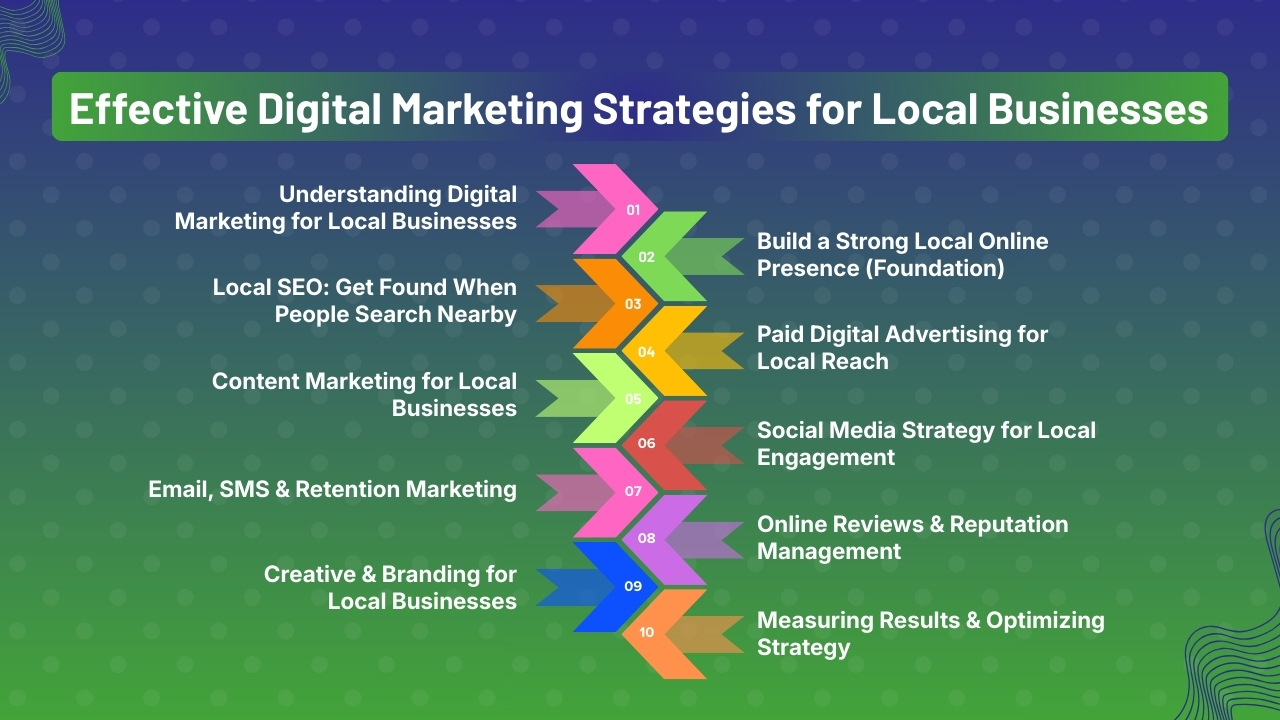
1. Understanding Digital Marketing for Local Businesses
Digital marketing for local businesses involves gaining attention of customers in your nearby area and converting that attention into real results. Unlike national brands that focus on wide reach.
Local businesses focus on targeted visibility appearing for the right people at the right time, especially when people are searching with local intent.
The main objective of Digital marketing is to appear in Google Search and Google Maps when someone searches for your service, build customer trust with strong reviews and helpful content, and guide customers to take action quickly.
That customer action can be a phone call, a direction request, a booking, a form inquiry, on an in-store visit. A strong local digital strategy connects every channel. Local SEO and a well-optimized Google Business Profile attract high-intent customers who are actively searching.
2. Build a Strong Local Online Presence (Foundation)
Before investing in ads or trying to grow your business on social media, make sure you build a strong local online foundation so every campaign performs better.
Because when people search for a service “near me”, customers usually choose from the first few results they trust so it is essential to show up clearly.
Google Business Profile (GBP)
For most local businesses, a well-optimized Google Business Profile is the first major driver because it appears directly in Google Search and Google Maps.
Your Google Business Profile shows up directly in Google Search and Google Maps. Start by verifying your profile, then select the most relevant category so Google clearly understands your services.
Keep your Google Business Profile details like address, phone, website, and business hours accurate and perfectly match your website and social profile for maximum trust and visibility. Upload real, high-quality images of your store, team, products.
Collect customer reviews regularly and respond to reviews professionally, because reviews strongly influence clicks, calls, and direction requests.
An optimized GBP helps you appear in local results, Maps listings, and high-intent searches like “best” or “near me”.
Local Website Optimization
Your website should answer three questions instantly:
-
What do you do?
-
Where are you located?
-
How can someone contact you?
Keep your website simple, focused, and designed to guide visitors toward calling, booking. Since most local searches happen on phones, use a mobile-friendly design and place CTA buttons like Call Now, Book Appointment, or Get a Quote.
3. Local SEO: Get Found When People Search Nearby
Local SEO helps nearby customers find your business when they search for services in your city or area.It helps your business appear in Google local results, Google Maps, and high-intent searches like “plumber near me” or “best salon in the city”.Though it takes time, local SEO delivers long-term, cost-effective leads without paying for every click.
On-page optimization
Your website pages should clearly describe your services and location so Google understands about your services and location where you serve customers.
Include your city, neighborhood, or service area to key spots like page titles, headings, and meta descriptions to strengthen your local relevance.
Add service-area details, an embedded Google Map, and contact information in the footer of every important page consistently.
Local citations
Build strong local citations by listing your business on platforms like Justdial, Apple Maps, Bing Places, and trusted inventory directories to improve local visibility.
Maintain the same NAP details across all listings with the same spelling, formatting, and phone number because even small inconsistencies can weaken your local SEO rankings.
4. Paid Digital Advertising for Local Reach
Organic marketing takes longer to gain customer trust while paid ads deliver instant local visibility and generate leads when you need it the most.
Instead of waiting months for rankings or followers, paid ads appear in front of nearby customers instantly, especially people who are already searching for your service.
The best strategy is to win customers who are ready to buy on Google first, then use social media ads to make your brand familiar through repeated reminders.
Google Search & Map Ads displays your business in front of people the moment when they need help. When someone searches for “plumber near me,” “best cafe in the city," search ads can place you at the top of results.
These clicks are high quality because the user has clear intent and is ready to call, book, or visit. As you are charged only for clicks, you can control expenses more easily.Retargeting past visitors helps your brand to stay familiar when customers are ready to buy.
Local businesses do not need big budgets to win online, rather they need the right marketing strategy. A smart marketing plan helps businesses to appear when nearby customers search, compare prices and decide, converting attention into visits, bookings, and sales.
Start with local SEO which involves optimizing websites for “near me” and city keywords, improve page loading, and create conversion focused pages with clear call-to-actions.
Then optimize your Google Business Profile with the right Name, Address, and Phone Number(NAP), the right categories, updated hours, high-quality images, products, services, and weekly posts to improve your brand visibility in Google Maps and local search.
To grow faster, combine Google Search PPC with geo-targeted Facebook and Instagram ads and retarget past visitors when they are ready to buy.
Customer trust drives better marketing results, so prioritize reputation management by collecting regular reviews, responding to reviews quickly and politely, and featuring customer testimonials across your websites and ads.
Measure performance using Google Analytics and conversion tracking, then monitor KPIs like leads, cost per lead, and revenue per campaign to know what is working.
Also Read: What are five marketing strategies that retailers spend half of their annual budget on?
Effective Digital Marketing Strategies for Local Businesses
1. Understanding Digital Marketing for Local Businesses
Digital marketing for local businesses involves gaining attention of customers in your nearby area and converting that attention into real results. Unlike national brands that focus on wide reach.
Local businesses focus on targeted visibility appearing for the right people at the right time, especially when people are searching with local intent.
The main objective of Digital marketing is to appear in Google Search and Google Maps when someone searches for your service, build customer trust with strong reviews and helpful content, and guide customers to take action quickly.
That customer action can be a phone call, a direction request, a booking, a form inquiry, on an in-store visit. A strong local digital strategy connects every channel. Local SEO and a well-optimized Google Business Profile attract high-intent customers who are actively searching.
2. Build a Strong Local Online Presence (Foundation)
Before investing in ads or trying to grow your business on social media, make sure you build a strong local online foundation so every campaign performs better.
Because when people search for a service “near me”, customers usually choose from the first few results they trust so it is essential to show up clearly.
Google Business Profile (GBP)
For most local businesses, a well-optimized Google Business Profile is the first major driver because it appears directly in Google Search and Google Maps.
Your Google Business Profile shows up directly in Google Search and Google Maps. Start by verifying your profile, then select the most relevant category so Google clearly understands your services.
Keep your Google Business Profile details like address, phone, website, and business hours accurate and perfectly match your website and social profile for maximum trust and visibility. Upload real, high-quality images of your store, team, products.
Collect customer reviews regularly and respond to reviews professionally, because reviews strongly influence clicks, calls, and direction requests.
An optimized GBP helps you appear in local results, Maps listings, and high-intent searches like “best” or “near me”.
Local Website Optimization
Your website should answer three questions instantly:
-
What do you do?
-
Where are you located?
-
How can someone contact you?
Keep your website simple, focused, and designed to guide visitors toward calling, booking. Since most local searches happen on phones, use a mobile-friendly design and place CTA buttons like Call Now, Book Appointment, or Get a Quote.
3. Local SEO: Get Found When People Search Nearby
Local SEO helps nearby customers find your business when they search for services in your city or area.It helps your business appear in Google local results, Google Maps, and high-intent searches like “plumber near me” or “best salon in the city”.Though it takes time, local SEO delivers long-term, cost-effective leads without paying for every click.
On-page optimization
Your website pages should clearly describe your services and location so Google understands about your services and location where you serve customers.
Include your city, neighborhood, or service area to key spots like page titles, headings, and meta descriptions to strengthen your local relevance.
Add service-area details, an embedded Google Map, and contact information in the footer of every important page consistently.
Local citations
Build strong local citations by listing your business on platforms like Justdial, Apple Maps, Bing Places, and trusted inventory directories to improve local visibility.
Maintain the same NAP details across all listings with the same spelling, formatting, and phone number because even small inconsistencies can weaken your local SEO rankings.
4. Paid Digital Advertising for Local Reach
Organic marketing takes longer to gain customer trust while paid ads deliver instant local visibility and generate leads when you need it the most.
Instead of waiting months for rankings or followers, paid ads appear in front of nearby customers instantly, especially people who are already searching for your service.
The best strategy is to win customers who are ready to buy on Google first, then use social media ads to make your brand familiar through repeated reminders.
Google Search & Map Ads displays your business in front of people the moment when they need help. When someone searches for “plumber near me,” “best cafe in the city," search ads can place you at the top of results.
These clicks are high quality because the user has clear intent and is ready to call, book, or visit. As you are charged only for clicks, you can control expenses more easily.Retargeting past visitors helps your brand to stay familiar when customers are ready to buy.
5. Content Marketing for Local Businesses
Content marketing helps local businesses to build customer trust early because by the time customers are ready to call, visit, or book, your business already feels like a good choice.
Local content works best when it is practical, focused on your area, and quick for customers to buy or visit. The fastest content win is blog posts that answer real customer questions.
The fastest content win is blog posts that answer real customer questions. Turn common questions about pricing, timing, process, and best options from calls or WhatsApp into simple local topics like cost guides and comparison posts.
Local guides and “best of” content also perform well because they connect your business with the community. Posts like “Best cafes for work in the city” attract local attention even when people are not ready to buy yet.
Share behind the scenes reels and customer stories to add trust and emotion with simple images, short videos, and quick tips.
6. Social Media Strategy for Local Engagement
By showing the real people behind your brand, social media builds local trust and helps you stand out from nearby competitors. So post consistently, stay professional, and make calling or messaging you effortless.
Keep content real and local. Post quick clips of daily work, team at work, and share customer testimonials using photos, short videos which will strongly influence local decisions.
Promotions like limited-time discounts and seasonal deals will be effective. Since reels get the most reach, keep them simple with 10 second clips, product demos, process videos, or quick tips.
Also, share local events, festivals, and collaborations to stay connected with your community, and focus on consistency because posting 3 to 4 times a week can noticeably improve reach, trust, and inquiries.
7. Email, SMS & Retention Marketing
Acquiring new customers is becoming more expensive every year for local businesses that are competing in the same sector. That is why retention matters because repeat customers purchase faster, trust your business more, and mostly refer friends and family.
Email and SMS are cost-effective, high-impact channels which keep customers connected to your business and lead more repeat purchases. It builds long-term relationships by delivering value and not just discounts.
Use email to share promotions, service updates, helpful updates, and seasonal reminders that keep customers engaged.
For instance, salons can send hair-care tips, clinics can send checkup reminders. Expand your email list using website forms, loyalty program enrollments.
SMS marketing works well because most messages are opened quickly, giving you a fast way to reach customers with timely updates or offers.
Also Read: How Great User Experience Increase Conversion and Builds Customer Trust
8. Online Reviews & Reputation Management
Online reviews are one of the strongest trust indicators for local businesses and often play a big role in whether customers choose you. Before visiting, most people quickly check Google ratings and reviews to ensure whether they are making the right choice.
If your reviews look active and genuine, customers feel confident. If you have no reviews or only old ones because people hesitate and often choose a competitor.
Reviews don’t just help rankings rather they increase conversions by bringing in more calls, direction requests, walk-ins, bookings. It reduces customer hesitation by answering the questions that customers might have about quality, pricing, cleanliness, and reliability.
Respond to every review professionally by thanking positive reviewers and handle negatives calmly with solutions. Focus on honest, recent reviews of long-term benefits.
9. Creative & Branding for Local Businesses
Creative and branding are not just for big companies. For local businesses, branding creates the first impression and often decides whether people visit you or move on to a competitor.
A simple, professional brand makes your business feel established, reliable, and trustworthy. Start with a logo that looks good on a shop board, Google Business Profile, and a mobile screen.
Choose 2-3 brand colors and 1-2 fonts so your websites, ads, posters, and social media feel connected.
Start with a logo that looks good on a shop board, Google Business Profile, and a mobile screen. Choose 2 or 3 brand colors and 1 or 2 consistent fonts so your websites, ads, posters, and social media look connected.
Use real photos of your storefront, teams, products, and happy customers as much as possible. Stock images can sometimes work but real images build stronger because people get to see the actual experience they will get.
Clear messaging equally matters as website design. Clearly communicate about your offers, who you cater, and why you are the best choice whether it is because of fast service, fair pricing, premium quality.
Also Read: Design That Converts Why UX is the New Sales Funnel
10. Measuring Results & Optimizing Strategy
Digital marketing works best when you track results and optimize your content regularly. Without tracking, you are just guessing results. With tracking, you get to know about the channels that bring actual leads, ads that waste budget, and changes that will increase calls, bookings, and sales.
Key metrics to watch: Begin with tracking website traffic and then monitor visit count. Check which pages people often visit, how long they stay on the pages. Track your actual lead actions with phone calls, WhatsApp clicks, form submissions, and online bookings because it indicates buyer intent.
If you have a physical location, monitor direction requests and store visits through Google Business Profile and ad reports. For paid advertising, always measure ad cost against revenue so you know your actual ROI.
Track your conversion rate (visitors who become leads) and improve it with clearer CTAs, better offers, and faster page speed.
Tools that help: Use Google Analytics for tracking website behavior, Google Business Insights for tracking local visibility and calls, and ad dashboards for tracking clicks, leads, and cost. If you use a CRM, track lead quality and repeat purchases.
Conclusion
A strong digital marketing strategy for a local business is not about implementing all strategies, rather it’s about building the right system and improving it consistently.
Start with a strong foundation like an optimized Google Business Profile which should be clear and mobile-friendly website, and accurate business details across listings.
Then use local SEO to earn steady visibility when people search nearby, and combine it with paid ads for faster reach and predictable lead flow. Then support it with useful local content, consistent social posting, and real community engagement so your business feels trustworthy and familiar.
Customer retention is where long-term profit grows, so keep customers close through email, SMS, and simple loyalty efforts. Protect your reputation with steady review collection and professional responses, because reviews influence rankings and buying decisions.
Finally, track the numbers that matter like calls, bookings, store visits, conversion rate, and ad spend vs revenue so you can stop guessing and start scaling what works.
When your branding, messaging, and customer experience stay consistent across Google, your website, ads, and social media, you create a local presence that people remember. Over time, this strategy turns visibility into trust and trust into steady customers.
If you still have any query regarding digital marketing strategy for local business then you may write to us at bloggyhands and we are more than happy to assist you.
John Doe
Owner
Passionate about creating valuable content that helps businesses grow through digital marketing and innovative strategies.