

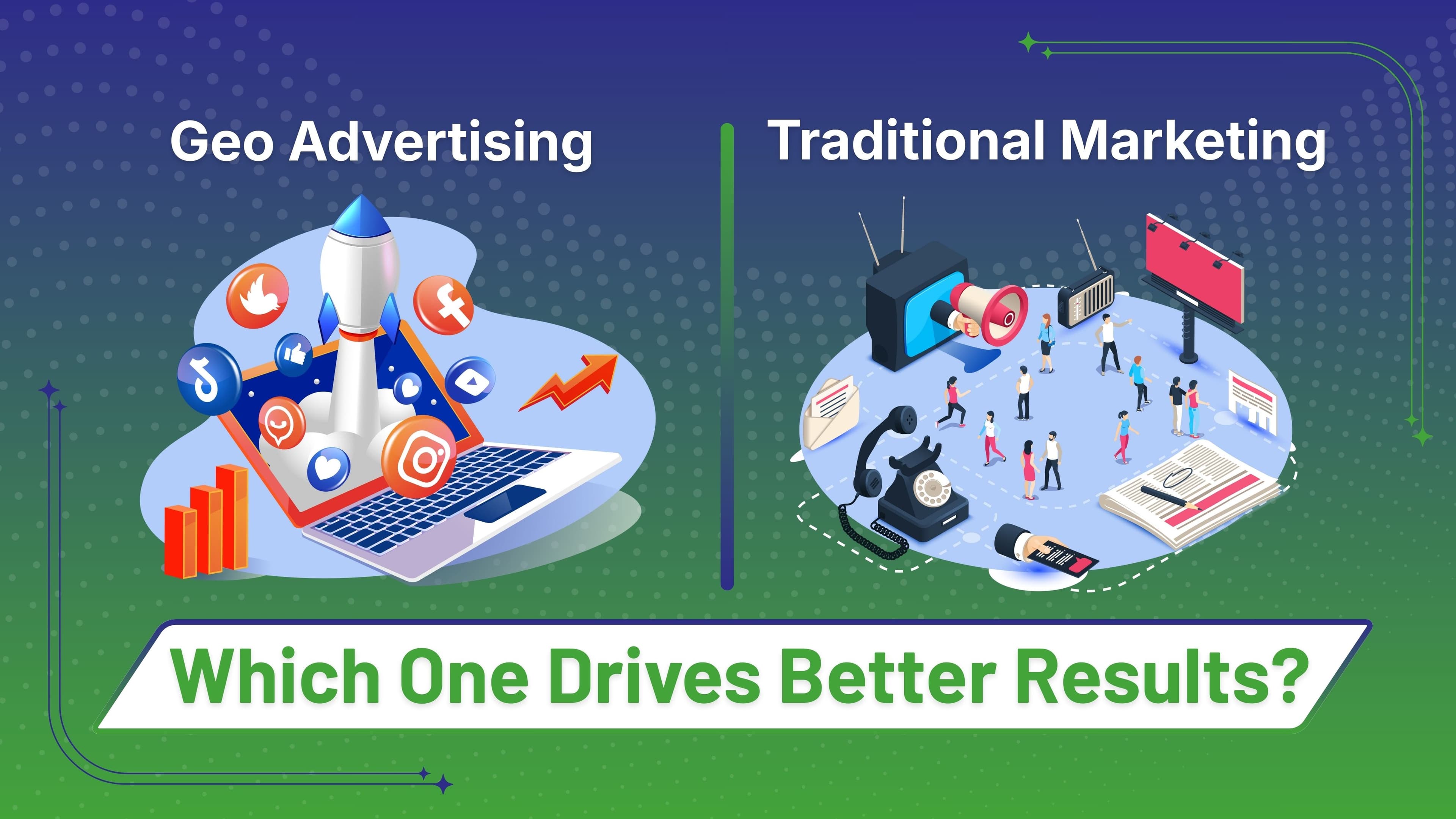
Marketing today is not just about being seen. It’s about being seen by the right people at the right time, with a message that actually moves them to act.That’s why the debate around Geo Advertising versus Traditional Marketing has become so important for businesses across the USA.
Whether you should invest in location-based ads that target people by city, ZIP code, radius, or even real-time proximity or should you use traditional marketing methods like billboards, flyers, radio, newspaper, and local sponsorships that build local awareness over time.
The actual fact is both Geo Advertising and Traditional marketing can drive results, but they work in different ways. Traditional marketing is designed for broad reach and continuous exposure.
For instance, a billboard on a busy highway, a radio spot during drive time, can create strong local awareness and credibility. But the actual challenge in traditional marketing is it is difficult to know who all saw your ad, what action they took, and how much sales were traditional marketing able to produce.
Geo advertising targets specific locations and tracks real actions, letting you clearly see how your budget turns into clicks, calls, store visits, and conversions. This type of advertising is essential for businesses that depend on local customers, foot traffic, and quick decision making.
Through this blog, we will break down the key differences between geo advertising and traditional marketing, compare cost, targeting, speed, tracking, and ROI, and help you decide which approach drives better results for your goals whether you want more walk-ins, more leads, stronger brand awareness.
What is Geo Advertising?
Geo advertising is a type of digital marketing which uses location data to deliver advertisements to people based on where they are or where they have been, so your message reaches nearby or location-relevant customers rather than everyone.
This type of advertising reaches people based on where they are and not everyone, so the message feels more relevant and makes the ad more useful and are more likely to convert customers.
At its centre, geo advertising involves targeting audiences based on several powerful ways. You can also reach your audiences on the basis of their real-time proximity, in which ads are delivered to users who are currently within a specific radius of your business.
It also involves targeting home or work location clusters, allowing brands to focus on neighborhoods where their ideal customers live or spend most of their day.
Another common method of geo advertising is visit-history targeting, which involves showing ads to people who have earlier visited certain places such as competitor stores.
Most advanced strategies include route or navigation intent, which shows ads to people who are travelling along the same routes. Other strategies involve geofencing where ads are shown when someone enters or leaves a virtual boundary around a location.
Because Geo advertising is location-aware, it works well for businesses who depend on local customers, foot traffic, or immediate action.
For instance, a restaurant can show ads to people within 3 km during lunch hours, when they are actively deciding when to eat.
What is Traditional Marketing?
Traditional marketing involves using offline advertising channels which people have been using for many decades to build visibility, and brand recognition within a community or region.
This type of marketing uses billboards and hoardings, transit ads on buses or trains, flyers, posters, and direct mail, radio and local TV commercials, newspaper and magazine ads, as well as event sponsorships and street marketing.
Unlike digital campaigns, traditional marketing places your message in the real world where people live, commute, shop, and spend time.Traditional marketing helps to create brand exposure. It helps to build familiarity and trust mainly for local businesses who want to build a strong presence in their area.
For many industries like real estate, healthcare, education, this type of visibility can play an important role in influencing long-term buying decisions.
However, traditional marketing usually comes with limited precision tracking. Even if you can estimate reach, it’s still hard to know who actually noticed the ad, how the ad influenced them, or what action they take next.
But still businesses may depend on indirect signs like an increase in foot traffic, phone calls, or brand recognition because there is no clear attribution data.
Despite this limitation, traditional marketing remains effective for brand awareness, credibility, and reinforcing brand presence when used consistently and strategically especially when combined with modern and data-driven marketing efforts.
GEO Advertising Vs Traditional Marketing
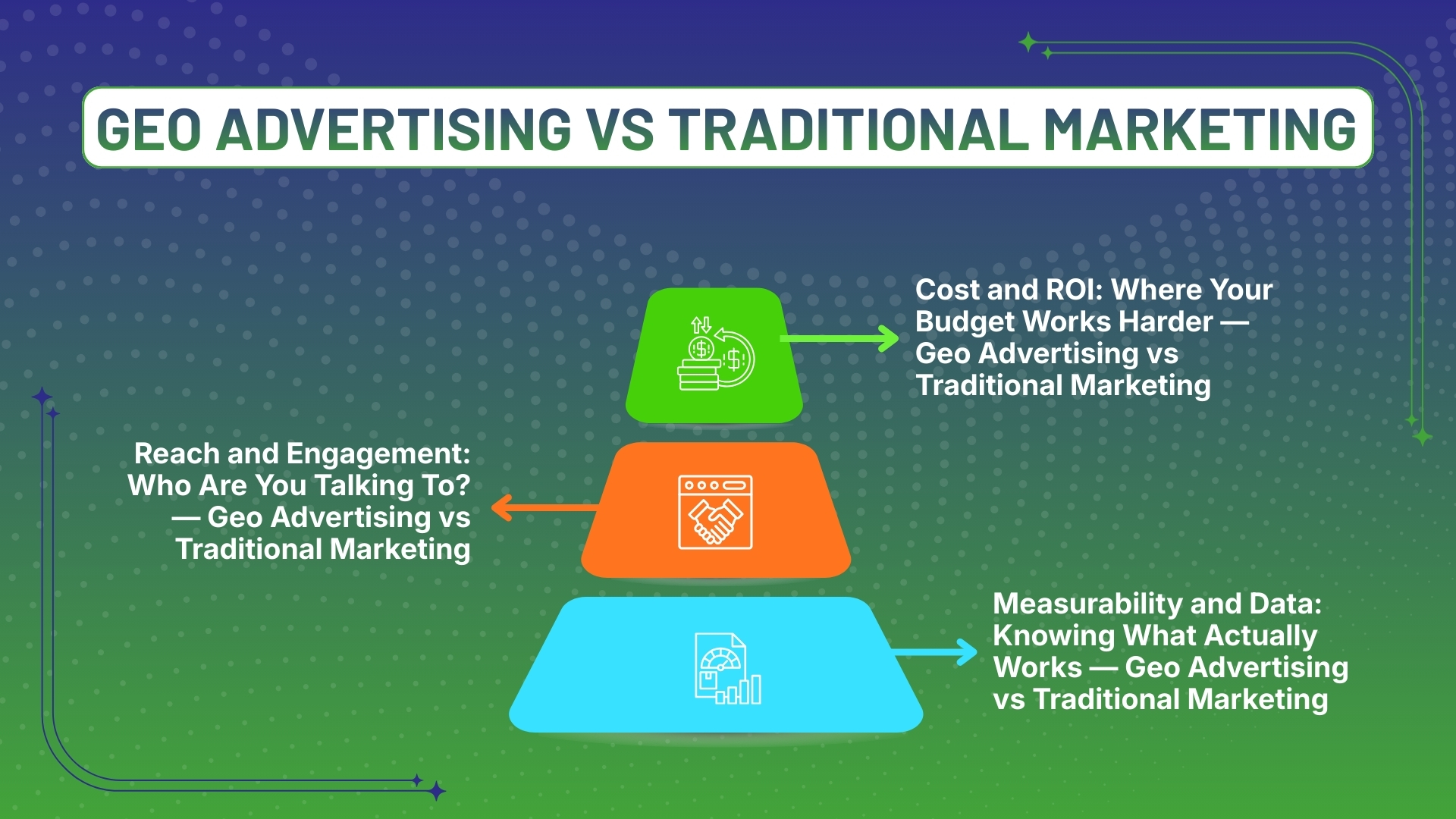
When you are deciding where to spend marketing money, but the actual question is not “Which marketing strategy is cheaper? Rather it is “Which gets measurable results faster and more consistently?”
Both geo advertising and traditional marketing can work, but they behave very differently in cost control, tracking, and ROI.
Geo Advertising: Higher control, clearer ROI
Geo advertising(Google location targeting, Facebook radius ads, geofencing, “near me” ads, and more usually delivers better return of investments when your goal is leads, visits, calls, bookings, or sales you can measure.
The biggest cost advantage of geo advertising is precision. Rather than paying for ads to reach everyone in a city, you can target only the areas that actually buy, you can target only the areas that actually buy within specific neighborhoods, or even people near competitor locations.
With geo ads, you can:
-
Set a daily cap
-
Stop instantly if performance drops
-
Track clicks, calls, directions, form submissions, and conversions
-
Compare ROI city-by-city or neighborhood-by-neighborhood
That tracking is the real ROI engine. You can see exactly what is working and shift the budget toward the best zones, best offers. Over time, geo campaigns get stronger because you quickly spot which neighborhoods deliver leads and which locations keep wasting budget with little to show for it. Even in competitive cities where clicks are expensive, geo advertising usually performs better because you avoid paying for irrelevant audiences and keep optimizing week after week.
Traditional Marketing: Strong reach, weaker attribution
Traditional marketing like billboards, flyers, radio, print, local sponsorships which can still be powerful, especially for brand presence and trust. In some categories like restaurants, events, retail stores, seeing your name repeatedly in the physical world can create familiarity and social proof.
The cost challenge is that traditional channels often come with:
-
Larger upfront commitments(weeks or months locked)
-
Broad targeting(you pay for people who will never buy)
-
Limited tracking(you often feel impact but can’t measure it clearly)
It is difficult to measure return on investments from traditional marketing.Because though a billboard may increase awareness, it is still difficult to connect awareness directly to purchase unless you use certain tracking tools like unique coupon codes, dedicated phone numbers, or custom landing pages. Without those, traditional marketing trends to be measured by estimates like reach, impressions.
Where your budget works harder
-
If you want direct response then sales, leads, appointments, geo advertising usually works harder because you can measure, optimize, and scale what performs.
-
If you want local authority and visibility, traditional marketing can work, but return on investment improves only when you add tracking elements and you already have a strong offer.
Best approach for most local businesses
A smart strategy is hybrid use of geo advertising for performance(measurable ROI) and traditional marketing for credibility(brand life). But if the budget is less and you need results you can prove, geo advertising usually gives you the fastest feedback loop and that is where return on investment grows.
2. Reach and Engagement: Who Are You Talking To? — Geo Advertising vs Traditional Marketing
Marketing works well when the right people see your ads at the right time. That is why “reach” is not about how many people you are able to reach, rather it is about to whom your ads are delivered and whether they are likely to act.
Geo advertising and traditional marketing approach reach and engagement in two different ways, and it is only by understanding that difference helps you choose the channel that actually connects with your audience.
Geo Advertising: Target the people most likely to respond
Geo advertising focuses on precision reach. You are not delivering ads to “everyone in the city.” Rather you are conveying messages to the people in specific locations who match your intent like near your store, in your delivery radius, in a neighborhood that historically converts well, or even near a competitor’s business.
That means engagement is usually stronger because the message feels more relevant. A location-based ad can say:
-
“5 minutes from you — visit our outlet now”
-
“20% off for customers near Stadium Road”
When the content matches the viewer’s real-world context, engagement increases naturally. People click, call, request directions, or visit because the offer is connected to their current location or daily route.
Geo ads also let you adapt the message by zone like the same business can run different creatives for different neighborhoods based on needs, language, local landmarks, or buying behavior.
The biggest advantage is that geo advertising does not just reach rather it also helps you reach with intent. If someone searching for “best cafe near me” is much closer to taking action than someone randomly seeing a generic message.
Traditional Marketing: Broad reach, slower engagement
Traditional marketing using billboards, posters, flyers, radio, newspaper ads usually delivers mass reach, but not precise targeting. Through traditional marketing you are conveying your message to a wide group like commuters, residents, tourists, and people who might never be your customer. That does not make traditional marketing useless rather it just makes it less controlled.
Traditional marketing works well because it builds passive awareness through repeated exposure.For instance, with a billboard on a busy road might not get an immediate click from people, but it can create familiarity.
Though the audience might not respond today, they remember you later when they need that service. Radio ads and sponsorships work the same way in which you might not get immediate clicks or calls, but you create repeated visibility that makes your brand feel familiar and established.
However, engagement in traditional channels is usually indirect. People notice the ads, think about it, maybe mention it to others, and take action later. But without tools like QR codes, short links, or promo codes, it’s difficult to measure how many are actually engaged.
Who are you talking to, really?
-
With geo advertising, you are delivering messages to people who are based on where they are or have been, which often means they are closer to purchase behavior. Engagement is active with clicks, calls, map directions, and store visits.
-
With traditional marketing, you are delivering messages to the public at large. Engagement in traditional channels is often psychological where people remember you, trust you, and recognize your name then they take action later, which makes it harder to connect results back to one specific campaign.
When to use each channel for maximum impact
If your goal is local actions like footfall, bookings, and immediate leads, then geo advertising keeps your message in front of the people most likely to respond now. While if your goal is local authority like brand familiarity, credibility, then traditional marketing can support that, especially in high-traffic areas. For most businesses, the strongest strategy is using geo ads for precise engagement and traditional media for long-term presence.
3. Measurability and Data: Knowing What Actually Works — Geo Advertising vs Traditional Marketing
Marketing becomes far more profitable when you can measure results and improve results over time. This is where geo advertising and traditional marketing differ the most: geo advertising is built on data and real-time feedback, while traditional marketing often depends on estimates unless you add tracking.
Geo Advertising: Built for measurement and optimization
With geo advertising, performance is measurable by default. You can track impressions, clicks, direction requests, website visits, and conversions like leads, bookings, purchases when tracking is set up.
The biggest advantage is speed where you don’t have to wait weeks to know if something is working. By analyzing results across neighborhoods, radius, zip code, or city, you can quickly know which areas deliver the lowest cost per lead and the highest conversion rates.
This creates a continuous improvement where you shift your expenses toward the best areas, pause low-performing areas, test new creatives, and offers, refine targeting, and use the data to improve results week after week with less wasted expenses.
Traditional Marketing: Measurement is possible, but not automatic
With traditional marketing like billboards, flyers, radio where measurement is possible, but it’s not automatic. Most results are indirect like awareness, recall, and trust.
You may see more walk-ins or brand recognition, but it’s hard to identify which channel exactly drove the lift, especially when seasonality and word of mouth also influence sales.
Traditional campaigns often get evaluated by estimated reach, impressions, or flyer distribution totals, but those metrics don’t clearly show whether the budget turned into sales or revenue.
Traditional marketing becomes more measurable only when you design clear response paths such as unique coupon codes, QR codes, and short links to a dedicated landing page. These tools connect the gap between offline visibility and measurable actions like calls, visits, and purchases.
-
If your goal is to know what marketing strategies actually work and improve brand visibility with data, then geo advertising is the best option.
-
Traditional marketing can still be valuable for brand presence, but it delivers strong ROI when tracking is built into the campaign from the first day.
Conclusion
Both geo advertising and traditional marketing can produce results, but they drive performance in two different ways. The best option depends on whether you want measurable action now or broad awareness over time.
Geo advertising which includes Google location targeting, “near me” ads, radius campaigns, geofencing, Meta local ads usually drives stronger short-term results because it targets people based on their location. That precisions reduces wasted reach.
You can show ads only in high-converting areas, around competitor locations, or within a delivery radius. More importantly, geo ads are trackable where you can measure clicks, calls, direction requests, form fills, and conversions, then optimize fast.
If one area performs poorly, then you pause geo advertising in that area. While if another area delivers leads at a lower cost, you can scale it. This creates a feedback loop that improves return on investment week after week.
Traditional marketing like billboards, flyers, radio, print, sponsorships is better at building familiarity and trust especially in local markets where repeated visibility matters.
A billboard on a busy route or a radio spot during commute hours can make your brand feel established. The challenge with traditional marketing is measurability because without tools like QR codes, unique coupon codes, or dedicated phone numbers, it’s harder to connect expenses directly to sales. Engagement is often delayed, and results can combine with word-of-mouth, seasonality, or competitor activity.
So, which drives better results? If your goal is to achieve leads, bookings, store visits, or sales you can prove, geo advertising usually wins because it is precise and data-driven.
But if your goal is presence, recall, and credibility, traditional marketing can still be valuable, especially when combined with tracking and a strong offer. For most businesses, the best results come from a hybrid strategy and use geo ads for performance, and traditional media for authority.
If you still have any query regarding which one drives better results between geo advertising and traditional then feel free and write to us at bloggyhands and we are more than happy to assist you.
John Doe
Owner
Passionate about creating valuable content that helps businesses grow through digital marketing and innovative strategies.