

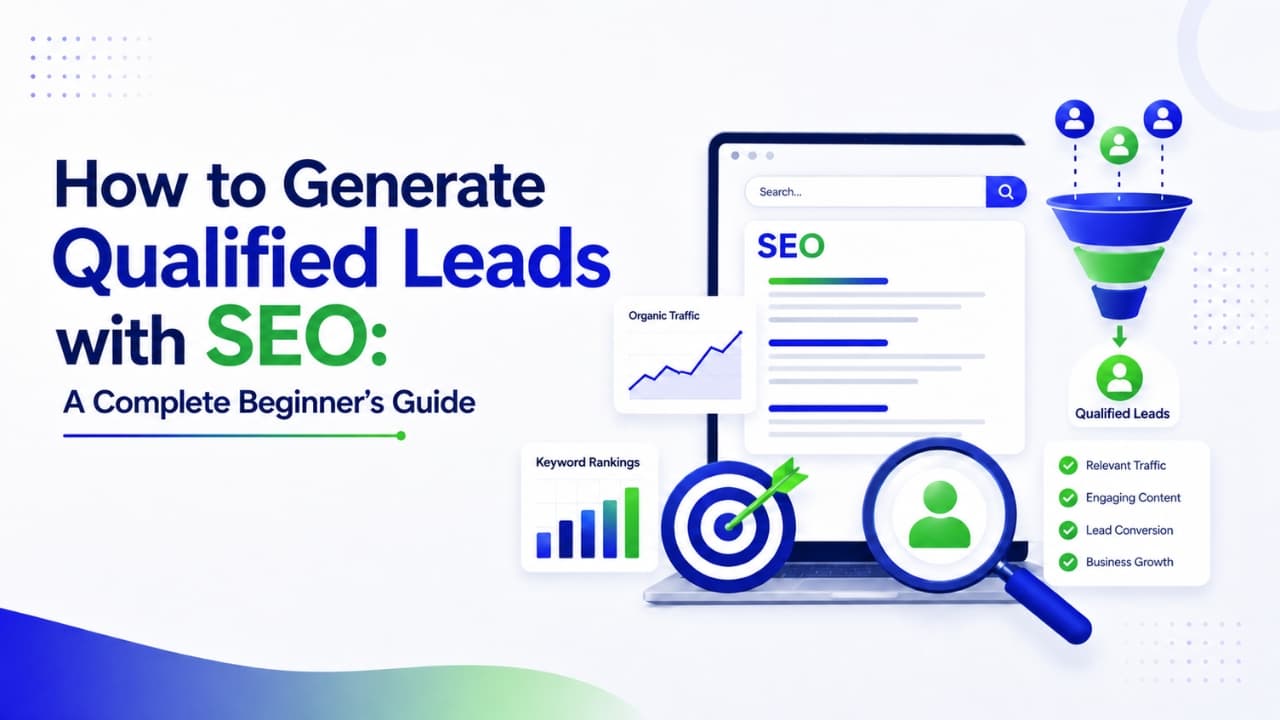
Generating traffic from search engines is useful but traffic alone cannot ensure business growth. The real value of SEO is being able to attract the right visitors and convert them into qualified leads.
These are people who are searching for your products, services, or solutions and are most likely to become customers.
SEO lead generation is the process of using search engine optimization for bringing high-intent visitors to your website and guide them toward actions such as filling out a form, booking a consultation, requesting a quote, downloading a guide, or calling your business.
Instead of going behind random clicks, this approach involves reaching the people with real interest and clear buying intent.
A strong lead generation SEO strategy starts with understanding your target audience, their concerns, and the search terms that the visitors may use.
Strategies include selecting high-intent keywords, creating helpful content, optimizing landing pages, improving website structure, and adding clear calls to action.
When all elements work together, then your website becomes a powerful lead-generation engine rather than a digital brochure. This becomes a system for attracting, educating, and converting potential customers.
The goal of SEO is simple is to connect your content with what your ideal customers are already searching for. Whether they are comparing options, learning about a problem, or ready to hire a provider, your website should provide the right information at the right time.
With the right SEO approach, you can increase organic traffic, improve conversion rates, and generate better-quality leads consistently.
Also Read: The Great User Experience Increases Conversions and Builds Customer Trust
What Is SEO Lead Generation?
SEO lead generation involves attracting people from organic search and converting them into potential customers. These are not random visitors. Rather they are people searching for information, services, solutions, comparisons, prices, or providers related to your business.
For instance, someone searching “how to choose a CRM for a small business” may not be ready to buy immediately. But they are showing interest in a problem your business might solve. Someone searching “best CRM software for real estate agents” is closer to comparing options. Someone searching “CRM software free demo” is much closer to taking action.
A strong SEO lead generation strategy understands these different search phases. Many businesses improve rankings and traffic but still fail to generate qualified inquiries because their SEO does not align with real buying behavior.
That is the major difference between ordinary SEO and lead-focused SEO. Ordinary SEO may focus heavily on rankings and traffic. Lead-focused SEO asks a better question which is “Are we attracting people who are likely to become customers?”
Also Read: Digital Marketing Strategy for Local Businesses
Why Search Intent Matters
Search intent is the reason behind a user’s search. It tells you what the person wants to do. They may want to learn, compare, buy, visit a specific website, or solve a problem.
For generating leads, search intent is extremely crucial because not every keyword has the same business value. A keyword with high traffic may bring many visitors but few leads while a keyword with lower traffic but stronger buying intent may bring fewer visitors and better results.
Search intent usually falls into four categories:
-
Informational intent: The user wants to learn something.
-
Commercial intent: The user is comparing options.
-
Transactional intent: The user is ready to take action.
-
Navigational intent: The user is looking for a specific brand, website, or page.
Informational searches are useful for awareness, commercial searches, support evaluation, transactional searches which show readiness to act, and navigational searches that often reflect existing brand awareness.
For instance, “what is SEO lead generation” is informational, while “best SEO agency for lead generation” shows a commercial intent, and “hire an SEO consultant for lead generation” indicates a transactional intent as each requires a customized page, messaging approach, and call to action.
Start with Your Ideal Customer Profile
Before you choose keywords or write content, you require to know who you want to attract. An unclear audience creates weak content while a clear audience creates focused pages that interact directly with real problems.
Your ideal customer profile should answer questions like:
-
Who is your best-fit customer?
-
What result do they want?
-
What questions do they ask before buying?
-
What objections stop them from contacting you?
-
What keywords would they actually search?
A strong SEO lead generation foundation begins with understanding your ideal customer and how they search for solutions online. It further suggests going beyond generic personas and identifying specific pain points, goals, and search language.
For instance, “small business owner” is too broad. While a better profile would be “local dental clinic owner looking for more appointment bookings from Google.”
This gives you a clearer SEO direction. You can create pages about local SEO for dentists, dental marketing strategies, appointment lead generation, and dental website conversion tips.
Also Read: How to Get Your Business on Google
Choose High-Intent Keywords
Keyword research for lead generation should not just focus on search volume. Because high-volume keywords can be useful, but they are not always profitable.
While the better approach is to find keywords that show business intent.
High-intent keywords often include words like:
-
best
-
pricing
-
agency
-
consultant
-
service
-
software
-
near me
-
quote
-
demo
-
provider
-
comparison
-
solution
-
company
-
for small business
For instance, “SEO” is broad. “SEO agency for law firms” is more specific. “SEO services pricing for law firms” is even closer to a lead generating keyword.
It is essential to find the exact phrases people use when they are close to making a purchase or signing up, instead of targeting basic “what is” searches.
A good keyword strategy should include both educational and conversion-focused keywords. Educational keywords build awareness and trust. Commercial and transactional keywords create stronger lead opportunities.
Also Read: Is Adding Too Many Keywords Bad for Google Ads
Map Keywords to the Sales Funnel
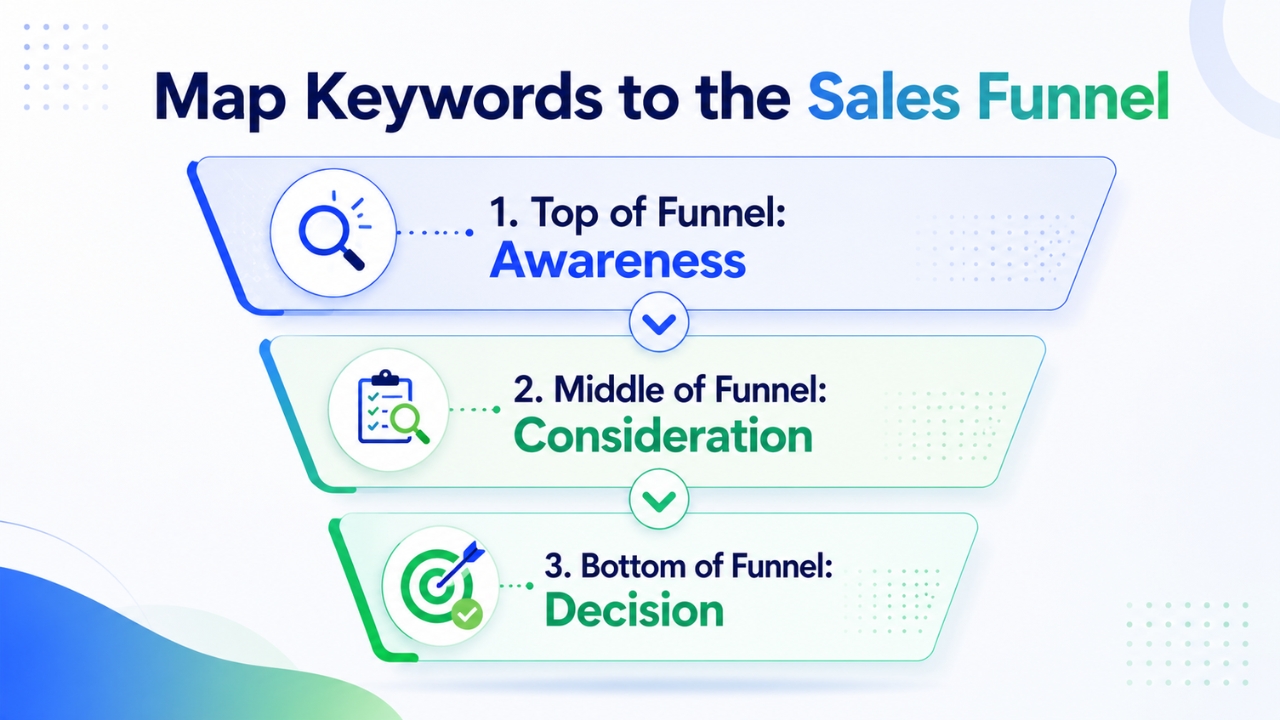
The best SEO lead generation strategy connects keywords to the customer journey. Every visitor is not ready to contact immediately. Because some visitors are learning, some visitors are comparing, and some visitors are ready to buy.
You can organize your SEO funnel like this:
1. Top of Funnel: Awareness
At this phase, people are trying to understand a problem. They are not ready to buy yet.
Good content types include:
-
Beginner guides
-
Educational blogs
-
How-to articles
-
Glossaries
-
Checklists
-
Problem-focused content
Example keywords:
-
“what is lead generation”
-
“how SEO helps small businesses”
-
“why my website is not getting leads”
The goal is to educate visitors and build trust.
2. Middle of Funnel: Consideration
At this phase, users are comparing methods, tools, vendors, or solutions.
Good content types include:
-
Comparison pages
-
Case studies
-
Buyer guides
-
Industry-specific guides
-
Service explainers
-
Problem-solution pages
Example keywords:
-
“SEO vs paid ads for lead generation”
-
“best SEO strategy for B2B companies”
-
“SEO agency vs in-house SEO”
At this phase, the goal is to help users evaluate their options.
3. Bottom of Funnel: Decision
At this phase, users are ready to act.
Good content types include:
-
Service pages
-
Pricing pages
-
Demo pages
-
Consultation pages
-
Quote request pages
-
Location pages
Example keywords:
-
“hire SEO agency”
-
“SEO lead generation services”
-
“SEO consultant near me”
-
“book SEO consultation”
It also suggests aligning your SEO strategy with the awareness, consideration, and decision stages, since each phase requires unique distinct content types and keyword focus.
Also Read: What is Remarketing Monitoring
Create Content That Solves Real Problems
Google’s SEO indicates useful and attractive content that can strongly influence search visibility. It recommends writing content that is easy to read, well organized, unique, up to date, reliable, and people-first.
For generating leads, your content should do more than just explain a topic. It should enable the reader to move forward with clarity and confidence. A good article should answer the search query, explain the problem clearly, show practical steps, and naturally guide the reader toward the next action.
For instance, a blog titled “How to Improve Restaurant Sales with SEO” should not just define SEO. It should explain local keywords, Google Business Profile optimization, menu page SEO, review signals, location pages, and booking CTAs. Then it should offer a useful next step, such as a free local SEO audit or consultation.
Strong SEO content includes:
-
Clear headings
-
Short paragraphs
-
Practical examples
-
Simple explanations
-
Internal links
-
FAQs
-
Strong calls to action
Businesses must avoid writing only for search engines. Keyword stuffing, generic content, and copied information will not build trust. Your content must feel like it was written for a real person with a real problem.
Use Lead Magnets and CTAs
Traffic only creates real value when visitors turn into leads , customers, or measurable business outcomes. That is why every crucial SEO page should include a clear call to action.
A CTA tells users what to do next. Examples include:
-
Book a free consultation
-
Request a quote
-
Download the checklist
-
Get a free audit
-
Start your free trial
-
Compare pricing
-
Talk to an expert
-
Schedule a demo
Lead magnets are useful resources businesses offer to encourage visitors to share their contact details. Every article, guide, or case study should direct readers toward a clear next step using a strong CTA and a valuable lead magnet.
Examples of lead magnets include:
-
Free audit
-
PDF checklist
-
ROI calculator
-
Buyer’s guide
-
Case study
-
Template
-
Free tool
-
Industry report
-
Email course
The lead magnet should align with the content. If the blog is about improving website conversions, the lead magnet could be a “Website Conversion Checklist”. If the page is about SEO for contractors, the CTA could be “Get a Free Contractor SEO Audit.”
Optimize Landing Pages for Leads
Blogs attract and educate visitors, but landing pages often convert them. A landing page focused on generating leads should be clear, specific, and easy to act on.
A strong landing page should include:
-
One main topic
-
One clear audience
-
One primary CTA
-
Strong headline
-
Clear benefits
-
Trust signals
-
Simple form
-
FAQs
-
Testimonials
-
Proof or case studies
-
Fast loading speed
-
Mobile-friendly design
A landing page must not be overloaded with too many distractions. When your goal is a consultation, make the CTA direct and easy to follow. When your goal is a quote request, keep the form short because asking too many questions too soon can reduce conversions.
Lead capture works best when forms are simple, CTAs are placed strategically, and visitors can take the next step with less effort. A good landing page does not show what you offer, rather it explains why it is essential, who it is for, what problems it solves, and what the visitor should do next.
Improve Technical SEO and Website Experience
Technical SEO helps search engines to discover, understand, and index your website. It also improves user experience, which is essential for lead generation.
Google explains that it primarily finds pages through links from pages that it already crawled, and websites can also submit sitemaps to help Google discover important URLs.
Important technical SEO areas include:
-
Mobile-friendly design
-
Fast page speed
-
Clean URL structure
-
Proper internal linking
-
XML sitemap
-
Indexable pages
-
Secure HTTPS
-
Clear navigation
-
Fixed broken links
-
Proper canonical tags
-
Optimized title tags
-
Useful meta descriptions
Google also recommends organizing sites logically so users and search engines can understand how pages relate to each other. For large sites, grouping similar pages in directories can help Google to understand site structure.
For generating leads, technical SEO is not just about crawling. It is also about building trust and usability. If your site loads slowly, looks broken on mobile, has confusing navigation, or uses long forms, visitors may leave before becoming leads.
Build Internal Links and Authority
Internal links help users to move through your website and help search engines to understand your content. For instance, a blog about “SEO for accountants” can link to your “Accounting SEO Services” landing page. A guide about “local SEO tips” can link to your “Local SEO Services” page.
According to Google, links play a crucial role in guiding both users and search engines to relevant content across the web. Using clear and descriptive anchor text also helps people and search engines to better understand the topic and context of the linked page.
A good internal linking strategy connects:
-
Blog posts to service pages
-
Service pages to case studies
-
Case studies to consultation pages
-
FAQs to detailed guides
-
Location pages to relevant service pages
-
Comparison pages to demo or quote pages
Authority from trusted external sources also plays a crucial role. Backlinks, mentions, partnerships, digital PR, and useful resources can help to improve visibility. Create valuable link-worthy resources like original research, detailed guides, free tools, templates, calculators, or industry reports.
For generating leads, authority-building content should not be random. It should attract an accurate audience and support your commercial pages.
Measure SEO Lead Generation Performance
You cannot improve SEO lead generation if you only track rankings and traffic. Those metrics are useful, but they do not show the complete business impact.
You should track:
-
Organic traffic
-
Organic leads
-
Conversion rate
-
Form submissions
-
Phone call clicks
-
Demo bookings
-
Quote requests
-
Lead magnet downloads
-
Keyword rankings
-
Landing page conversions
-
Cost per lead
-
Lead quality
-
Closed deals from organic traffic
Set up conversion tracking in GA4(Google Analytics 4) and connect it with Google Search Console to understand which pages and user actions are generating actual business results.
Rather than focusing only on traffic volume, measure how many qualified leads your organic visitors generate and whether those leads contribute to actual growth, revenue, and business outcomes.
Conclusion
Generating qualified leads with SEO is not about attracting everyone rather it is about reaching the right people with clear intent and genuine interest in their offerings.
By defining your ideal customer profile and understanding how they search at different phases such as awareness, consideration, and decision, you can create targeted content that meets their requirements at every step.
Whether informative blog posts, comparison pages, and service-focused landing pages, each piece of content should guide users closer to taking action.
Equally crucial are the technical and strategic elements of SEO. Optimizing your website for speed, mobile usability, and search engine visibility ensures that your content is both accessible and competitive.
Building authority through quality backlinks and maintaining a strong internal linking structure further improves your rankings and credibility.
Finally, success comes from consistency and continuous improvement. Monitor your performance, refine your keyword strategy, and update your content regularly.
When done effectively, SEO becomes a reliable, long-term system that not only drives traffic but consistently delivers high-quality leads ready to convert into customers.
If you still have any query about how to generate qualified leads with SEO then you may book a free demo at bloggyhands and we are more than happy to assist you.
John Doe
Digital Marketing Expert
Passionate about creating valuable content that helps businesses grow through digital marketing and innovative strategies.