


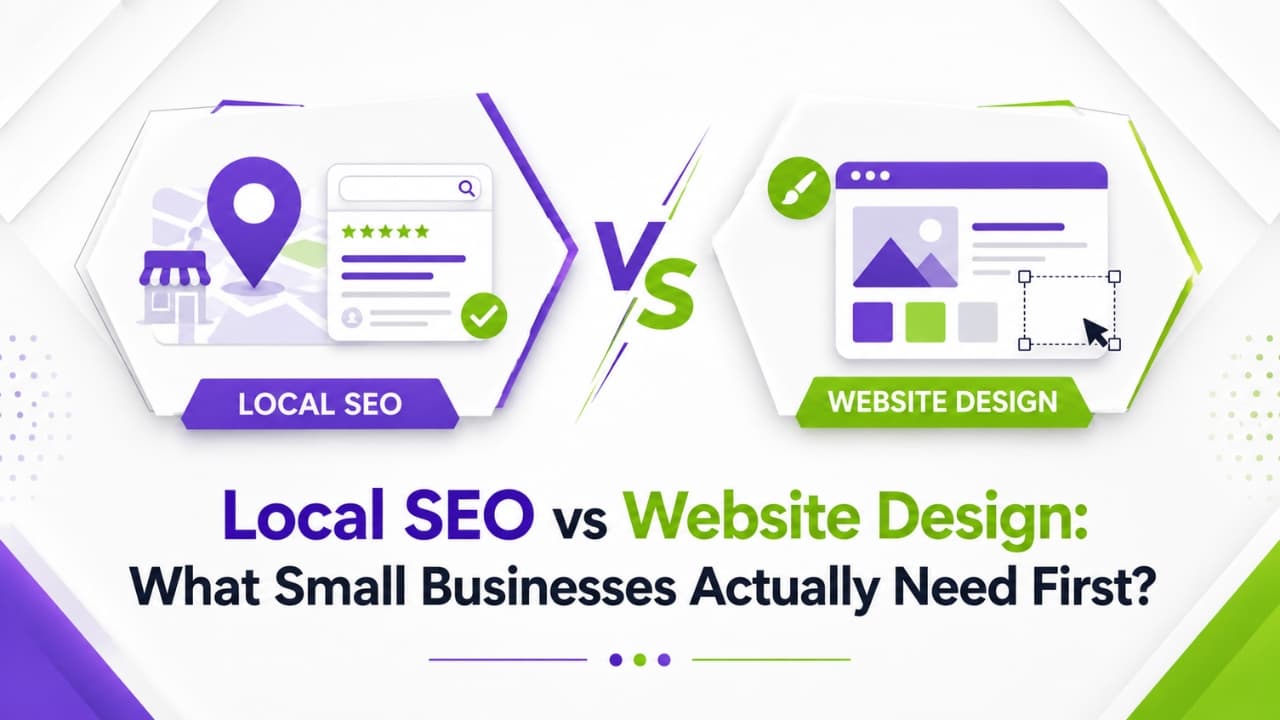
In today’s digital first market, small businesses often struggle with a crucial decision: Local SEO vs Website Design: What Small Businesses Actually Need First.
Though small businesses need both local SEO and website design to establish an online presence, knowing where to start can directly impact visibility, lead generation, and long-term growth.
Having a professional website design helps to establish credibility, build trust among potential customers and ensures a smooth user experience across devices.
On the contrary, local SEO helps businesses to improve search visibility, that helps businesses to appear in Google Search and Google Maps when customers are searching actively for nearby services.
While the main challenge is that many small businesses invest in one while neglecting the other causing limited results.
A visually attractive website without local SEO optimization may remain hidden to potential customers, while strong SEO without a well-designed website cannot be successful in converting visitors into leads.
This is where discussion about website design vs local SEO is essential for business owners who are trying to achieve maximum return on investment.
Ultimately, success of small businesses depends on understanding how both local SEO and website design has to be implemented together to drive traffic, improve website rankings, and convert visitors into customers.
Through this blog, we will walk you through what small businesses actually need first, how each component contributes to growth, and how to create a balanced approach which supports both visibility and conversion.
Also Read: Why Holly Spring Businesses Need Professional Web Design
Understanding Website Design for Small Businesses
Website design is the foundation of an online presence for small businesses. It is the digital identity of a business through which customers get to know about your business and services first.
This includes visual elements like layout, color scheme, typography, and branding, and functional components such as navigation, page structure, mobile responsiveness, and overall user experience.
A well-designed website helps businesses to show their professionalism and business reliability while also guiding visitors smoothly through information and services.
While website design has strong first impressions on customers, but while designing website design, businesses should consider the usability of a website which leads to conversions and delivers good business results.
1. Builds Trust and Credibility
A professionally well designed website creates a strong first impression on visitors and instantly indicates legitimacy. Visitors often judge a business within seconds, and a clean, modern interface helps to earn trust of customers. Developing a poor or outdated design can instantly reduce customer trust and cause potential customers to leave.
Also Read: Explain How Social Media Has Impacted Marketing for Small Businesses
2. Improves User Experience
A good website design ensures that users are easily able to navigate through your website. Visitors should be able to easily find essential information about businesses such as services, pricing, contact details, and service areas.
Offering a simple, intuitive website reduces any type of frustration for customers to find crucial details and keep visitors engaged for longer duration.
Also Read: How Get User Experience Increases Conversions and Builds Customer Trust
3. Supports Conversions
Through a website businesses must not just provide information about your services but also should actively generate leads.
Effective web design includes adding clear calls-to-action, inquiry forms, click-to-call buttons, and booking features that encourage users to take the next action.
Also Read: How to Generate Qualified Leads With SEO a Complete Beginners Guide
Understanding Local SEO
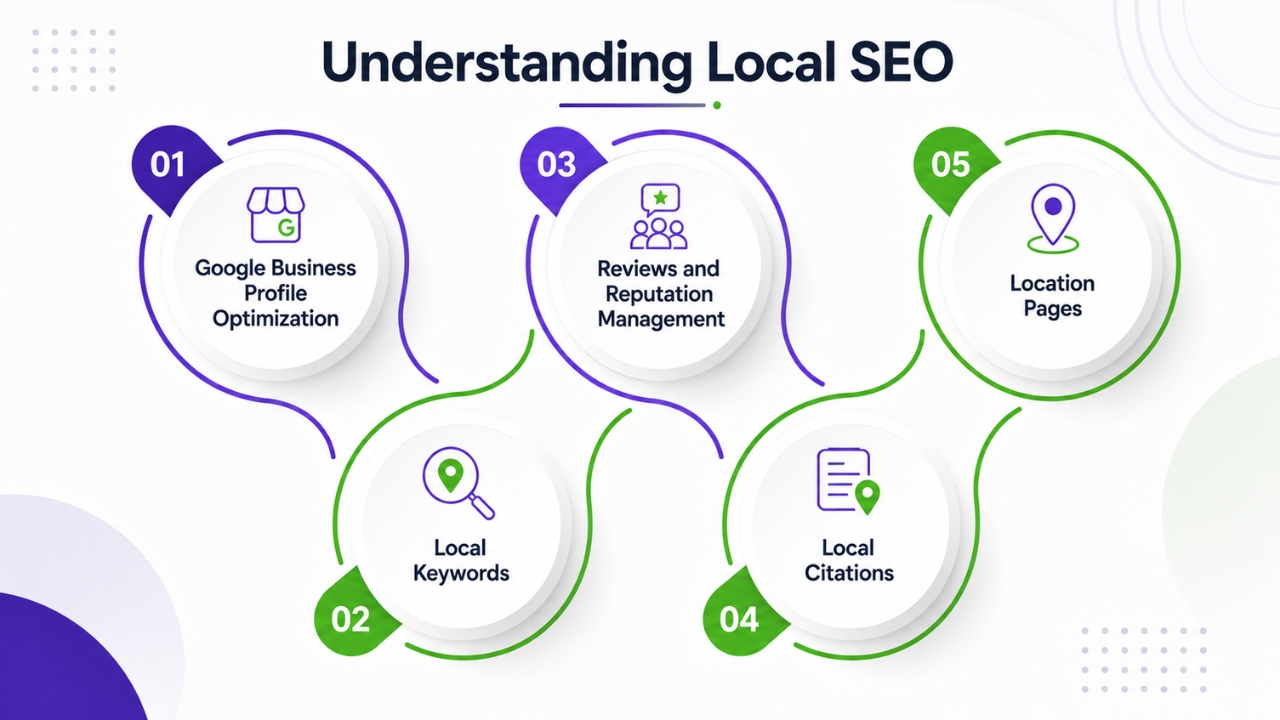
Local SEO(Search Engine Optimization) involves visibility of a business in location-based search results on platforms like Google Search and Google Maps.
It ensures that your business appears in the search results when potential customers search for services like “AC repair near me” or “plumber in my area”.
Unlike traditional marketing, local SEO involves attracting customers who are actively searching for services in a specific location. Due to which local SEO is highly effective for small and service-based businesses.
Local SEO helps search engines to understand the location where your business operates, what services your business offers, and how trustworthy your business is.
When local SEO is implemented correctly, local SEO increases visibility, drives customer traffic, and generates consistent local leads. It is essential for competitive industries where customers often select from the top few results shown in Google Maps or local listings.
1. Google Business Profile Optimization
Your Google Business Profile is one of the most crucial elements of local SEO. Google Business profile displays essential information of your business such as business name, address, phone number, reviews, services, and photos. A well-optimized Google Business profile increases visibility of your business and improves trust among potential customers.
Also Read: How to Get Your Business on Google
2. Local Keywords
Local SEO involves using location-based keywords like “HVAC services in Ahmedabad” or “electrician near me”. Such keywords help search engines to align your website with users who are searching for the same services you offer in your area.
Also Read: What is GEO Advertising & Marketing
3. Reviews and Reputation Management
Customer reviews are also essential for improving local rankings of your business. Businesses that have more positive reviews appear higher in search results and gain more customer trust.
Consistently gathering customer reviews and responding to reviews strengthens credibility.
4. Local Citations
Local citations are online mentions of your business on online directories such as Yelp, Justdial, and industry-specific platforms. These listings validate your business information and improve trust and authority of your business on search engines.
5. Location Pages
Businesses creating dedicated pages for different services helps businesses to target multiple cities or neighborhoods. These pages improve relevance in local searches and increase the chances of your businesses appearing on location-specific queries.
Website Design vs Local SEO: The Core Difference
Website design and local SEO are closely related to each other but have different purposes in online strategies of a small business.
Website design helps businesses to build trust, improve user experience, and turn visitors into customers through clear website design structure, images, and strong calls-to-action. When visitors visit your website, proper website design lets them easily understand your services and take the next action.
On the contrary, local SEO helps businesses to increase visibility of your website, and customer traffic. Local SEO helps businesses to appear in search results and Google Maps when people are actively searching for services in your area.
Local SEO helps businesses to reach their potential customers by improving visibility of your business through targeted keywords, optimized business profiles, and customer reviews, which ensures that the right audience finds your business while they search online for specific business or services.
Though local SEO helps businesses to bring visitors to your website, the website design converts those visitors into leads and then customers. Without a strong website design, visitors who visit your businesses may not convert into customers effectively.
Also Read: Design that Converts: Why UX is the New Sales Funnel
Key Differences
1. Website Design = Trust and Conversion
Website design focuses on creating an engaging user experience through proper layouts, strong branding, and compelling calls-to-action.
2. Local SEO = Visibility and Traffic
Local SEO increases online visibility of your businesses and website traffic by improving search rankings, presence on Google Maps, and helping businesses to get found by nearby customers.
3. SEO brings users in, design converts them
SEO attracts potential customers to your website, while effective website design helps to convert those visitors into leads.
Also Read: Is Adding Too Many Keywords Bad for Google Ads
Why Small Businesses Struggle With This Decision
Small businesses often struggle to decide whether they need to invest in website design and local SEO due to limited resources and unclear priorities.
With most small businesses, they do not have the budget to fully invest in both local SEO and website design at the same time, which forces them to choose one strategy over another. It often causes an imbalance in digital marketing efforts that fail to give consistent results.
Because important issues many small businesses face is due to the absence of a clear and well-defined digital marketing strategy. Many businesses consider website design and SEO as separate tasks instead of being interconnected.
As a result, businesses may build an attractive website without considering search visibility, or they may focus on SEO without ensuring that the website is optimized for conversions.
Another common problem with many businesses being not able to prioritize the right digital marketing efforts at the right phase of growth.
Some business owners assume that simply having a website will instantly generate leads, while other businesses believe that SEO alone is enough to drive sales without a strong website experience. While both assumptions are incorrect and can lead to wasted time and resources.
Also Read: What are the Five Marketing Strategies that Retailers Spend Half of their Annual Budget on
Why Website Design Matters First (In Some Cases)
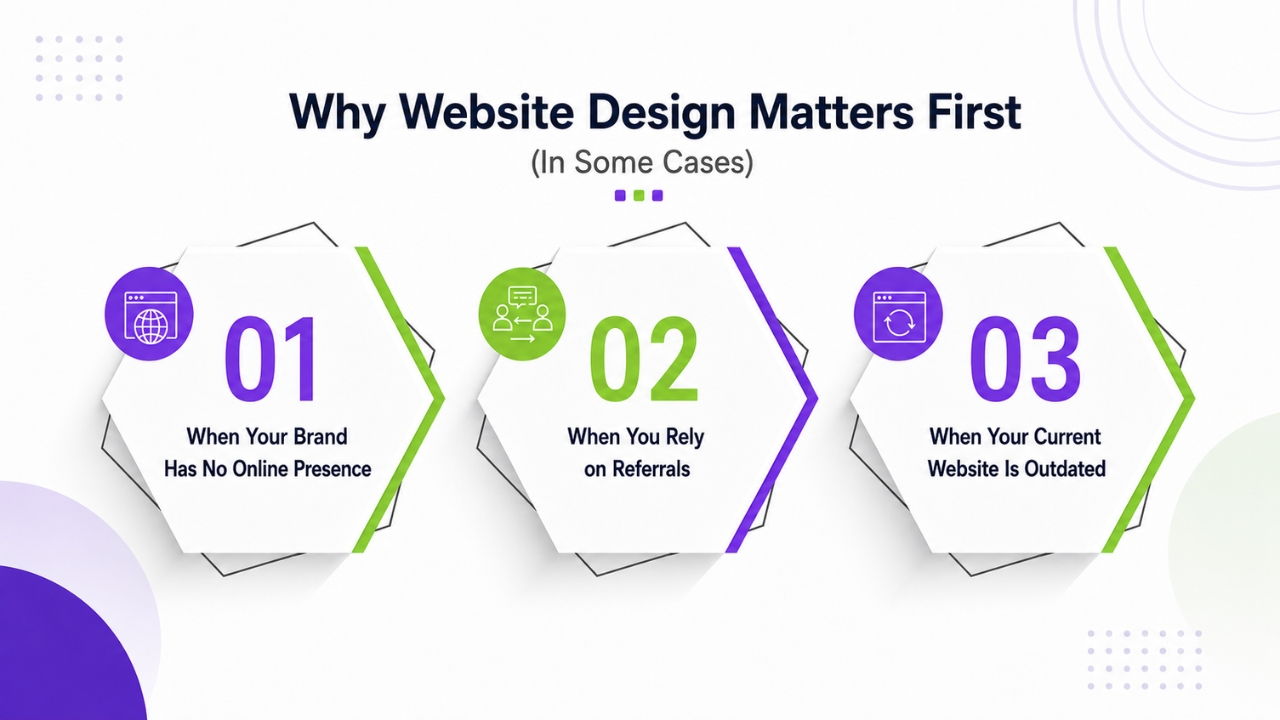
1. When Your Brand Has No Online Presence
When your brand has no presence online, it can reduce customer trust and credibility. Because most people expect businesses to have a website where they can know about your services and contact details.
Without having a strong online presence, businesses may seem outdated or less reliable that causes potential customers to rather select your competitors.
2. When You Rely on Referrals
When businesses depend on referrals, your website design is crucial for visitors to make decisions. Because even referred customers will visit your website to verify credibility of your business and learn more about your services.
A well-designed website helps businesses to gain trust of customers, maintain your brand reputation, and increase the chances that referrals convert into paying customers.
3. When Your Current Website Is Outdated
When an existing website is outdated, it can highly reduce conversions even when your SEO is performing well. Because poor website design, slow loading speed, or confusing navigation can push visitors away to your competitors.
Also Read: Best HVAC Website Design Features that Generate More Leads
Why Local SEO Matters First (In Other Cases)
Local SEO becomes the priority when:
1. You Already Have a Functional Website
When your business already has a functional and usable website, the next priority of businesses should be to improve business visibility through local SEO.
This ensures that customers can actually find your services on search engines like Google. Without proper visibility, even a well-built website will not generate traffic or leads.
2. You Operate in a Competitive Market
If businesses are into highly competitive industries such as HVAC, plumbing, dental, and real estate, local SEO becomes crucial as customers mainly search online for nearby service providers.
Strong visibility in local search results helps businesses to stand out from their competitors and attract high-intent customers who are actively searching for services in their area.
3. You Need Immediate Leads
When a business needs to generate instant leads, local SEO is the quick solution while compared to a full website redesign.
This helps your businesses to appear in local search results where customers are actively looking to purchase services. This improves visibility of your business and connects you with potential customers who are ready to convert.
Conclusion
In conclusion, the choice between local SEO and website design should not be viewed as one replacing the other, but rather as determining the strategy should take priority based on needs and goals of your current business.
A strong website design builds trust, improves user experience, and ensures that visitors convert into customers, while local SEO drives visibility and brings traffic from search engines.
Small businesses with no online presence should start with a simple, conversion-focused website, whereas those businesses with an existing website should prioritize local SEO to increase visibility and generate leads.
If customer traffic exists but conversions are low, improving website design becomes essential.
Ultimately, long-term success comes from combining both strategies into a unified system where SEO attracts visitors, design converts them, and content supports both. When aligned properly, they create consistent growth, stronger branding, and more qualified leads for small businesses.
If you still have any query about local SEO vs Website design: what small businesses actually need first then you may book a free demo at bloggyhands and we are more than happy to assist you.
John Doe
Digital Marketing Expert
Passionate about creating valuable content that helps businesses grow through digital marketing and innovative strategies.